TLDR A new imaging method helps see and study touch nerve endings in mouse skin.
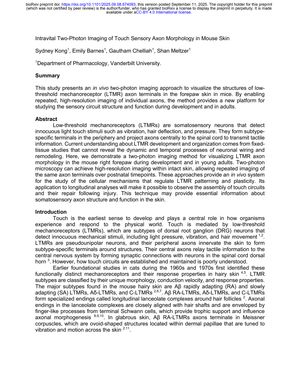
This study introduces a two-photon imaging technique to visualize low-threshold mechanoreceptor (LTMR) axon terminals in the forepaw skin of mice. This method allows for high-resolution, repeated imaging of axons in intact skin, facilitating the study of LTMR development, patterning, and plasticity over time. It offers a novel platform for observing the assembly and repair of touch circuits, providing valuable insights into somatosensory axon structure and function.
13 citations
,
August 2023 in “Developmental Cell” Mechanosensory neurons adapt to different skin types after birth.
 5 citations
,
March 2023 in “bioRxiv (Cold Spring Harbor Laboratory)”
5 citations
,
March 2023 in “bioRxiv (Cold Spring Harbor Laboratory)” Dynamic, light touch is sensed through a common mechanism involving Piezo2 channels in sensory axons.
 56 citations
,
June 2015 in “Nature Protocols”
56 citations
,
June 2015 in “Nature Protocols” Two-photon microscopy helps observe hair follicle stem cell behaviors in mice.
394 citations
,
October 2013 in “Nature” 660 citations
,
December 2011 in “Cell” Different hair follicles in the skin are innervated by unique combinations of mechanosensory neurons, crucial for touch sensation.
86 citations
,
May 2002 in “Journal of comparative neurology” Nerve growth in mouse skin and hair follicles happens in stages and is closely linked to hair development.
307 citations
,
November 1968 in “Journal of neurophysiology” Cats' hairy skin has different touch receptors connected by myelinated fibers.