TLDR A dog with complete hair loss regrew most hair after treatment, with no relapse after stopping treatment.
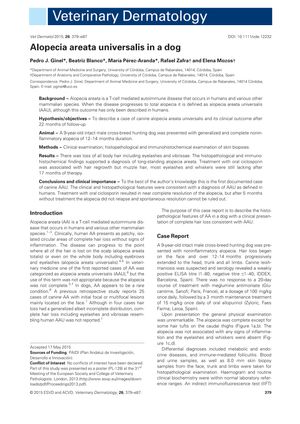
Alopecia areata universalis (AAU) in a 9-year-old male cross-breed hunting dog was documented, marking the first known case in canines. The dog exhibited complete noninflammatory hair loss for 12-14 months. Diagnosis was confirmed through clinical, histopathological, and immunohistochemical examinations. Treatment with oral ciclosporin led to significant hair regrowth, although some areas like the muzzle, eyelashes, and whiskers remained hairless after 17 months. After 5 months without treatment, the alopecia did not relapse, suggesting possible spontaneous resolution.
14 citations
,
February 2013 in “Veterinary dermatology” Horse alopecia areata is rare and mainly affects their appearance.
 21 citations
,
January 2013 in “Annals of dermatology/Annals of Dermatology”
21 citations
,
January 2013 in “Annals of dermatology/Annals of Dermatology” The combination of cyclosporine and PUVA might help treat severe alopecia areata.
 421 citations
,
April 2012 in “The New England Journal of Medicine”
421 citations
,
April 2012 in “The New England Journal of Medicine” Alopecia Areata is an autoimmune condition causing hair loss with no cure and treatments that often don't work well.
286 citations
,
August 2007 in “Journal of Clinical Investigation” Alopecia areata is an autoimmune disease where T cells attack hair follicles.
 16 citations
,
April 2007 in “Journal of Medical Primatology”
16 citations
,
April 2007 in “Journal of Medical Primatology” The monkey's hair loss was due to an autoimmune disease, not genetics.
 36 citations
,
January 2006 in “Veterinary Dermatology”
36 citations
,
January 2006 in “Veterinary Dermatology” Cyclosporin effectively and safely treated skin diseases in three pets with no side effects.
14 citations
,
August 2004 in “Veterinary Dermatology” The horse had a rare type of hair loss caused by immune cells attacking hair follicles.