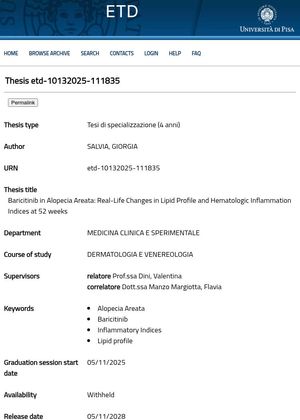
Baricitinib in Alopecia Areata: Real-Life Changes in Lipid Profile and Hematologic Inflammation Indices at 52 Weeks
October 2025
in “
Electronic Theses and Dissertations Repository (University of Pisa)
”
TLDR Baricitinib effectively treated alopecia areata in 73% of patients, with minor metabolic changes and significant changes in inflammatory markers.
The study investigated the effects of baricitinib on lipid profiles and hematologic inflammation indices in 37 patients with severe alopecia areata over 52 weeks. The treatment was well tolerated, with 73% of patients responding to baricitinib. Lipid profile changes were modest, with a significant increase in total cholesterol but non-significant fluctuations in LDL, HDL, and triglycerides. Among inflammatory indices, only the neutrophil/lymphocyte ratio (NLR) and platelet/lymphocyte ratio (PLR) showed significant changes, with PLR being higher in responders and emerging as the most sensitive marker of treatment response. Overall, the study concluded that baricitinib led to minor metabolic and hematologic variations, which were not clinically significant.