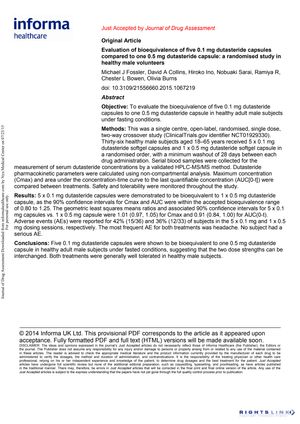
TLDR Taking five small dutasteride capsules is the same as taking one larger capsule.
In a study from 2013-2014 involving 36 healthy male subjects, it was found that taking five 0.1 mg dutasteride capsules is bioequivalent to taking one 0.5 mg dutasteride capsule under fasting conditions. The pharmacokinetic parameters, including maximum concentration (Cmax) and area under the concentration-time curve (AUC), fell within the accepted range for bioequivalence. Adverse events were reported in a similar proportion of subjects for both dosages, with no serious adverse events observed. The study, sponsored by GlaxoSmithKline, concluded that the two dosages can be interchanged and were generally well tolerated.
 97 citations
,
January 2014 in “Journal of The American Academy of Dermatology”
97 citations
,
January 2014 in “Journal of The American Academy of Dermatology” Dutasteride 0.5 mg works better than finasteride and placebo for increasing hair in men with hair loss.
24 citations
,
June 2013 in “Expert opinion on pharmacotherapy” Dutasteride effectively treats benign prostatic hyperplasia but isn't approved for preventing prostate cancer.
 92 citations
,
June 2010 in “Journal of The American Academy of Dermatology”
92 citations
,
June 2010 in “Journal of The American Academy of Dermatology” Dutasteride 0.5 mg daily improves hair growth safely in men with hair loss.
 215 citations
,
November 2006 in “Journal of The American Academy of Dermatology”
215 citations
,
November 2006 in “Journal of The American Academy of Dermatology” Dutasteride more effective for hair growth, but has more side effects than finasteride.
58 citations
,
March 2006 in “Current topics in medicinal chemistry” Dutasteride effectively treats benign prostatic hyperplasia and may reduce prostate cancer risk.
 179 citations
,
September 1998 in “BMJ”
179 citations
,
September 1998 in “BMJ” Hair loss in men is common, treatable, but not curable.
 416 citations
,
September 1997 in “Journal of Investigative Dermatology”
416 citations
,
September 1997 in “Journal of Investigative Dermatology” People with hair loss have more androgen receptors and enzymes in certain follicles, with men and women showing different patterns.
 143 citations
,
October 1996 in “Dermatologic Clinics”
143 citations
,
October 1996 in “Dermatologic Clinics” Too much androgen can cause hair loss; finasteride may help.