The Chronic Thermal Stress Model Of Androgenetic Alopecia: A Unified Environmental–Vascular–Molecular Hypothesis
April 2026
in “
Zenodo (CERN European Organization for Nuclear Research)
”
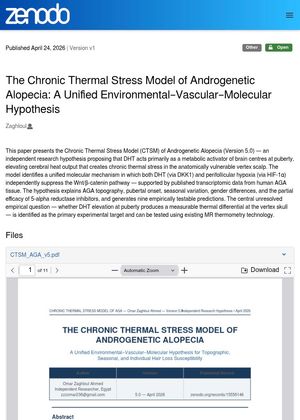
TLDR DHT increases scalp heat, causing hair loss.
The paper introduces the Chronic Thermal Stress Model (CTSM) of Androgenetic Alopecia, suggesting that dihydrotestosterone (DHT) acts as a metabolic activator at puberty, increasing cerebral heat output and causing chronic thermal stress in the vertex scalp. This model proposes that both DHT (through DKK1) and perifollicular hypoxia (via HIF-1α) independently inhibit the Wnt/β-catenin pathway, a theory supported by transcriptomic data from human AGA tissue. The hypothesis accounts for various aspects of AGA, including its topography, onset during puberty, seasonal variation, gender differences, and the limited effectiveness of 5-alpha reductase inhibitors. It also presents nine testable predictions, with the primary experimental focus being whether DHT elevation at puberty results in a measurable thermal difference at the vertex skull, which can be investigated using MR thermometry technology.