The Clinical Evaluation of Hirsutism

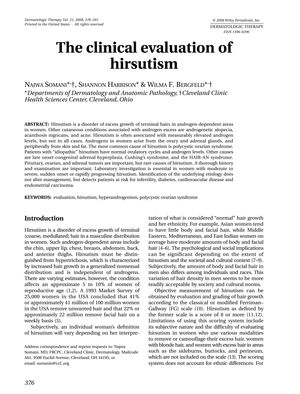
    September 2008 in “ Dermatologic therapy
    Najwa Somani, Shannon Harrison, Wilma F. Bergfeld
    Image of study
    TLDR Hirsutism is excessive hair growth in women often caused by polycystic ovarian syndrome, and identifying the cause is important for managing associated health risks.
    The document from 2008 discusses hirsutism, a condition characterized by excessive hair growth in women in areas typically associated with male hair patterns. It is often linked to elevated androgen levels, although not always. Androgens are produced by the ovaries, adrenal glands, and also in the skin and fat. The most frequent cause of hirsutism is polycystic ovarian syndrome, but it can also be due to idiopathic hirsutism, congenital adrenal hyperplasia, Cushing's syndrome, and HAIR-AN syndrome, with pituitary, ovarian, and adrenal tumors being rare causes. A detailed medical history and examination are crucial for patients, especially those with moderate to severe hirsutism, sudden onset, or rapid progression of the condition. Laboratory tests are essential to identify the cause, which, while not changing the management of hirsutism itself, is important for recognizing associated risks such as infertility, diabetes, cardiovascular disease, and endometrial carcinoma.

    Discuss this study in the Community →

    Research cited in this study

    9 / 9 results

    Related Community Posts Join

    6 / 29 results

      community Female, 30, PCOS diagnosis, MPB Norwood 2. Endo refuses to give anything other than Spironolactone. Feel like I’m at my wit’s end here.

      in Female  55 upvotes 2 years ago
      A 30-year-old female with PCOS and male pattern baldness is frustrated with her endocrinologist's recommendation of only Spironolactone and minoxidil, feeling that dutasteride, finasteride, and progesterone would be more effective. Other users suggest various online sources for treatments, warn against self-medicating due to potential risks, and recommend seeking a specialized endocrinologist or considering additional treatments like Inositol, Berberine, and dermaneedling.

      community How does hair loss and recovery work?

      in Chat  12 upvotes 1 year ago
      Hair loss varies due to genetic sensitivity to DHT and other factors. Treatments discussed include finasteride, minoxidil, RU58841, and microneedling.

      community Does low HGH leading to hairloss?

      in Research/Science  12 upvotes 2 years ago
      The user experiencing diffuse hair loss is using various treatments including RU58841, finasteride, minoxidil with tretinoin, anti-hair loss shampoo, and microneedling, and is considering adding peptides TB500, BPC157, and GHK-Cu. They have low growth hormone levels and are questioning its impact on hair loss, while another user suggests androgenic alopecia and androgens are likely the main cause of hair loss.

      community Any balding females? I need advice with coping :(

       18 upvotes 10 years ago
      A 27-year-old woman is struggling with hair loss, feeling self-conscious and seeking advice on coping. She mentions trying Minoxidil but is hesitant due to scalp issues and is looking for ways to regain confidence.

      community Dutasteride is amazing even for women with FAGA!

      in Female  151 upvotes 7 months ago
      Dutasteride significantly improved hair health and reduced shedding for a woman with PCOS and hyperandrogenism, without causing depression or anxiety, unlike finasteride. Dutasteride also helped with PMDD symptoms and had no side effects, though it changed hair texture.

      community Methionine? Glycine?

       6 upvotes 10 years ago
      The conversation discusses the potential benefits and risks of using Methionine and Glycine for hair loss, with concerns about cancer risk if not balanced properly. The user seeks opinions on these amino acids for hair health and overall benefits.

    Similar Research

    6 / 1000+ results