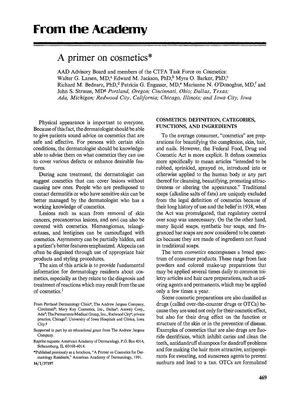
A Primer on Cosmetics for Dermatologists

    Walter G. Larsen, Edward M. Jackson, Myra O. Barker, Richard M. Bednarz, Patricia G. Engasser, Marianne N. O'Donoghue, John S. Strauss
    Image of study
    TLDR Dermatologists need to know about cosmetics to help patients with skin issues and recommend safe products.
    The document emphasizes the importance of dermatologists being knowledgeable about cosmetics to provide sound advice to patients, particularly those with skin conditions. Dermatologists should be able to recommend safe and effective cosmetics to cover defects, enhance features, and manage conditions like acne, contact dermatitis, sensitive skin, and alopecia. They should also be able to suggest products that can camouflage scars, hemangiomas, telangiectases, lentigines, and asymmetry without causing further skin issues. The article aims to educate dermatology residents on the fundamentals of cosmetics, including the diagnosis and treatment of reactions that may arise from their use.

    Discuss this study in the Community →

    Related Community Posts Join

    6 / 1000+ results

      community I'm becoming non-responder to minoxidil. What's going on?

      in Minoxidil  7 upvotes 4 months ago
      The user experienced reduced effectiveness of minoxidil after consistent use, despite using dutasteride to maintain hair. They are considering alternatives like microneedling and exploring options like hair transplants due to dissatisfaction with current hair density.

      community Does finasteride/dutasteride reverse aging?

      in Chat  45 upvotes 1 year ago
      Finasteride and dutasteride can improve skin texture and reduce acne by lowering DHT but do not reverse aging. They may enhance skin and hair health for some, but can also cause side effects like dry skin and sexual dysfunction.

      community Fats on your Head to Stop Hair Loss?

      in Research/Science  140 upvotes 1 year ago
      The conversation discusses the potential of long-chain unsaturated fatty acids, like oleic and linoleic acid, as an additional treatment for hair loss, which may inhibit the enzyme responsible for converting testosterone to DHT and promote hair growth. Users humorously suggest using oils topically and discuss other hair loss treatments, but the main focus is on the science behind fatty acids and their role in hair health.

    Similar Research

    5 / 1000+ results