Dirty Dots as a Normal Trichoscopic Finding in the Elderly Scalp

    January 2016 in “ JAMA Dermatology
    Mariya Miteva, Mariana Lima, Antonella Tosti
    Image of study
    TLDR Dirty dots are a common scalp finding in elderly women and can be washed away with shampoo.
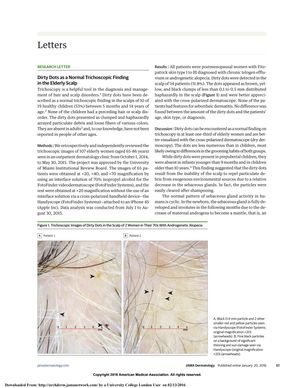
    The study, conducted between October 1, 2014, and May 30, 2015, retrospectively reviewed trichoscopic images of 107 elderly women aged 65-86 years diagnosed with chronic telogen effluvium or androgenetic alopecia. It found that "dirty dots," which are clumps of particulate debris and loose fibers, were present in the scalps of 34 patients (31.8%). These dots, which were brown, yellow, and black and measured less than 0.1 to 0.5 mm, were better visualized with a cross-polarized dermatoscope. The study concluded that dirty dots are a normal trichoscopic finding in at least one-third of elderly women and are not related to the patients' age, skin type, or diagnosis. The presence of dirty dots is likely due to the involution of sebaceous glands with age, as they were absent in patients with seborrheic dermatitis and are easily cleared with shampooing. The study emphasizes the importance of distinguishing dirty dots from other trichoscopic findings such as black dots, which are remnants of hair shafts and cannot be removed mechanically, and hair dye deposits, which are more diffuse and cannot be removed with shampooing.

    Discuss this study in the Community →

    Research cited in this study

    3 / 3 results

    Related Community Posts Join

    6 / 75 results
      If You Have DUPA, PLEASE READ THIS: Everyone Should Be Scalp Biopsied

      community If You Have DUPA, PLEASE READ THIS: Everyone Should Be Scalp Biopsied

      in Research  830 upvotes 1 year ago
      Scalp biopsies are crucial for diagnosing hair loss conditions like Diffuse Unpatterned Alopecia (DUPA) and retrograde hair loss, as treatments like finasteride and dutasteride may not be effective if other conditions are present. Combining PPAR-GAMMA agonists with retinoids could improve treatments for conditions like Lichen Planopilaris.

      community I bought a microscope, how does my scalp/hairs look? I've been suffering diffuse thinning and hair loss after covid and never recovered (2 yrs ago) I eat healthy, in shape and workout.

      in Progress Pictures  87 upvotes 1 year ago
      A person with hair loss since COVID-19 is considering treatments like finasteride and minoxidil but is hesitant due to potential side effects. Suggestions include visiting a dermatologist, using a ketoconazole shampoo, and considering that post-COVID hair loss might be an autoimmune response.

      community I think I’ve finally found the reason for my hair loss

      in Chat  98 upvotes 1 year ago
      The user experienced hair loss since 2019 and tried finasteride, dutasteride, RU58841, and ketoconazole shampoo without success. A scalp biopsy showed scarring and inflammation from folliculitis, indicating chronic inflammation was affecting treatment effectiveness.

      community The Fear of Oral Minoxidil is Overblown

      in Research/Science  272 upvotes 6 months ago
      Low-dose oral minoxidil is a safe and effective hair loss treatment with fewer side effects than previously feared. Users often prefer it over topical minoxidil for better results, though some experience side effects like increased body hair and cardiovascular issues.
      What hair loss pattern is this?

      community What hair loss pattern is this?

      in General  157 upvotes 4 weeks ago
      The user noticed small circular hairless spots after a buzz cut and has been using finasteride, dutasteride, and oral minoxidil for hair loss. They are experiencing continuous shedding and thinning, and it is suggested they consult a dermatologist for a scalp examination and possible biopsy to determine if it's alopecia areata or androgenetic alopecia.

    Related Research

    1 / 1 results