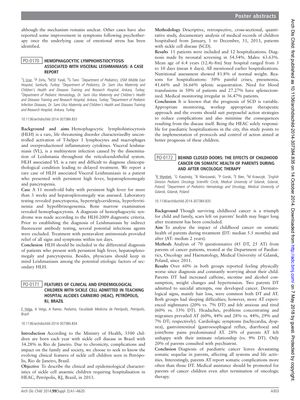
Behind Closed Doors: The Effects of Childhood Cancer on Somatic Health of Parents During and After Oncologic Therapy

    October 2014 in “ Archives of disease in childhood
    Rita Wyrebek, Gabrielle Karpinsky, B Warszawski, Peter A. Gorski, Ewa Bień, Małgorzata Krawczyk
    Image of study
    TLDR Childhood cancer diagnosis leads to long-term physical and emotional health issues in parents.
    The document reports on a study that aimed to analyze the impact of childhood cancer on the somatic health of parents both during treatment (DT) and after treatment (AT) of their child. The study involved 70 questionnaires completed by parents of cancer patients treated at the Department of Pediatrics, Oncology, and Haematology at the Medical University of Gdansk, Poland, since 2011. The results showed that over 60% of parents in both groups felt physically worse since the diagnosis and were constantly worried about their child. Parents DT experienced increased consumption of caffeine, nicotine, and alcohol, changes in weight, hypertension, and some had dermatological signs like hair loss. Two parents DT attempted suicide, and one developed cancer. Parents AT experienced more nightmares, anxiety, tiredness, headaches, concentration problems, migraines, cardiologic symptoms, gastrointestinal issues, and joint/bone pains than those DT. Additionally, 28% of parents AT were unhappy with their intimate relationships, and only 20% consulted with a psychiatrist. The study concluded that the diagnosis of pediatric cancer leaves devastating somatic sequelae in parents, affecting all systems and life activities, and that medical assistance should be promoted for these parents even after the oncologic therapy of their child has ended.

    Discuss this study in the Community →

    Related Community Posts Join

    6 / 1000+ results

      community Will Pp405 be the Ozempic of bald Guys

      in Research/Science  99 upvotes 1 week ago
      PP405 is being discussed as a potential hair loss treatment, possibly more effective than minoxidil. There are concerns about its effectiveness and product contamination, but some users report early signs of hair regrowth.
      If You Have DUPA, PLEASE READ THIS: Everyone Should Be Scalp Biopsied

      community If You Have DUPA, PLEASE READ THIS: Everyone Should Be Scalp Biopsied

      in Research  830 upvotes 1 year ago
      Scalp biopsies are crucial for diagnosing hair loss conditions like Diffuse Unpatterned Alopecia (DUPA) and retrograde hair loss, as treatments like finasteride and dutasteride may not be effective if other conditions are present. Combining PPAR-GAMMA agonists with retinoids could improve treatments for conditions like Lichen Planopilaris.

      community 9 Month Status Update. I am so glad I started when I did

      in Progress Pictures  1208 upvotes 1 year ago
      A user shared a 9-month update on hair loss treatment, reporting positive results from taking 1 mg of finasteride and 1.25 mg of minoxidil daily. The discussion includes varied experiences with these treatments, questions about side effects, and comments on the unpredictability of treatment effectiveness.

      community HMI 115 Phase 2 - Leaked pics from Discord

      in Research/Science  361 upvotes 1 year ago
      The conversation discusses HMI 115, a new hair loss treatment with promising results, showing a significant increase in hair density after two months. Some users are skeptical, while others are hopeful for its release and potential affordability.

      community Verteporfin and Microneedling

      in Treatments 1 year ago
      Clinical studies by Dr. Barghouthi and Dr. Bloxham indicate that Verteporfin, when used with FUE and FUT hair transplantation methods, shows promise in hair follicle regeneration and minimal scarring due to its ability to inhibit Yes-associated protein (YAP). Microneedling at depths of 3-3.5mm, combined with Verteporfin, could potentially reactivate dormant follicles, although the optimal dosage and application method are still under investigation. Concerns remain about the DHT sensitivity of regenerated follicles, highlighting the need for further research to optimize trauma levels and Verteporfin concentrations to achieve effective and scar-free hair regeneration.

    Similar Research

    5 / 1000+ results