Eosinophils in Fibrous Tracts and Near Hair Bulbs: A Helpful Diagnostic Feature of Alopecia Areata
July 1997
in “
Journal of The American Academy of Dermatology
”
TLDR Finding eosinophils near hair bulbs helps diagnose alopecia areata.
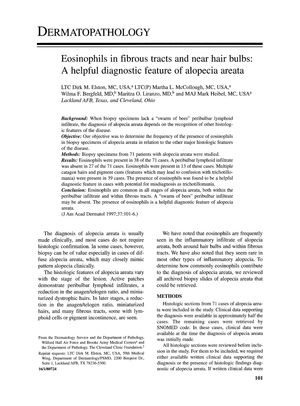
In the 1997 study involving 71 patients with alopecia areata, researchers found eosinophils in 38 cases, indicating that eosinophils are a common feature in all stages of the disease and can aid in diagnosis, particularly when the typical peribulbar lymphoid infiltrate is not present. The study also differentiated alopecia areata from trichotillomania, androgenic alopecia, and lipedematous alopecia by the absence of eosinophils in these conditions, but noted that syphilitic alopecia could not be distinguished from alopecia areata based on eosinophils or plasma cells alone. Additional findings included an increase in catagen hairs and pigment casts in alopecia areata, which could be confused with trichotillomania, highlighting the need for clinical correlation and serologic studies to accurately diagnose between syphilitic alopecia and alopecia areata.