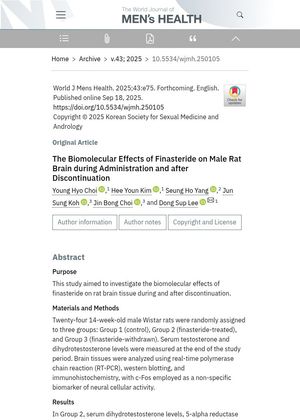
TLDR Finasteride temporarily suppresses brain activity, but some effects last even after stopping.
This study on male Wistar rats examined the effects of finasteride on brain tissue, focusing on 5-alpha reductase (5AR) and c-Fos protein expression. Twenty-four rats were divided into control, finasteride-treated, and finasteride-withdrawn groups. Finasteride administration significantly reduced 5AR type 2 and c-Fos protein levels, indicating suppressed neural activity. After discontinuation, 5AR type 1 and c-Fos levels rebounded, suggesting temporary suppression of neural activity that could be relieved by restoring 5AR type 1 expression. However, 5AR type 2 levels remained low even after withdrawal, indicating a prolonged effect of finasteride on this enzyme. The study highlights the need for further research to understand the detailed mechanisms of 5AR in brain tissue.
 7 citations
,
January 2019 in “The Aging Male”
7 citations
,
January 2019 in “The Aging Male” Post-finasteride syndrome's existence is uncertain; more research needed.
 17 citations
,
December 2018 in “The World Journal of Men s Health”
17 citations
,
December 2018 in “The World Journal of Men s Health” Long-term use of dutasteride can cause permanent erectile dysfunction in rats.
 58 citations
,
April 2017 in “The Journal of Steroid Biochemistry and Molecular Biology”
58 citations
,
April 2017 in “The Journal of Steroid Biochemistry and Molecular Biology” Post-finasteride patients show changed neuroactive steroid levels, possibly causing erectile dysfunction and depression.
 50 citations
,
March 2017 in “PeerJ”
50 citations
,
March 2017 in “PeerJ” Using finasteride or dutasteride may cause long-lasting erectile dysfunction.
 185 citations
,
March 2011 in “The Journal of Sexual Medicine”
185 citations
,
March 2011 in “The Journal of Sexual Medicine” Finasteride for hair loss can cause long-lasting sexual side effects like low libido and erectile dysfunction.
 16 citations
,
January 2010 in “Drug Metabolism and Pharmacokinetics”
16 citations
,
January 2010 in “Drug Metabolism and Pharmacokinetics” Finasteride's effect on hair loss and prostate enlargement depends on its binding to an enzyme, with maximum impact at 0.2 mg dose.
408 citations
,
May 2004 in “The Journal of clinical endocrinology and metabolism/Journal of clinical endocrinology & metabolism” Dutasteride more effectively lowers DHT levels in men with enlarged prostates than finasteride.
 93 citations
,
January 1996 in “Clinical Pharmacokinectics”
93 citations
,
January 1996 in “Clinical Pharmacokinectics” Finasteride helps regrow hair and shrink prostate by reducing DHT, with some sexual side effects.