TLDR Keratosis pilaris is common in young females, and dermoscopy helps diagnose it accurately.
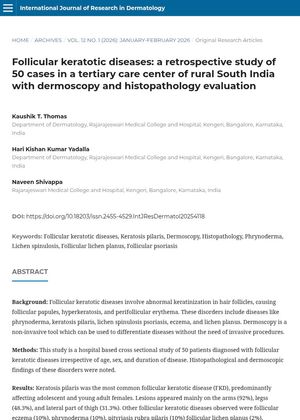
This retrospective study of 50 patients at a tertiary care center in rural South India focused on follicular keratotic diseases (FKD), with keratosis pilaris (KP) identified as the most prevalent condition, particularly affecting adolescent and young adult females. The study utilized dermoscopy and histopathology to differentiate FKD, highlighting the importance of these non-invasive techniques in accurate diagnosis and management. Dermoscopic findings included perifollicular scaling and erythema, while histopathology confirmed hyperkeratosis and follicular dilation. The research underscores the role of dermoscopy in distinguishing KP from other similar disorders, aiding in effective treatment strategies.

1 citations
,
March 2023 in “Tidsskrift for Den norske lægeforening” Keratosis pilaris is a common skin condition causing a bumpy texture, sometimes linked to other diseases, with various treatments available.
7 citations
,
February 2019 in “Anais Brasileiros de Dermatologia”
11 citations
,
August 2010 in “Pediatric dermatology” Tacalcitol cream effectively and safely treated a rare skin condition called Lichen Spinulosus in two cases.
April 2012 in “Informa Healthcare eBooks” Lichen planopilaris is a rare, chronic condition causing hair loss, mainly in middle-aged women, and early treatment is important to prevent permanent baldness.
7 citations
,
August 2021 in “Journal of the European Academy of Dermatology and Venereology” Early treatment of fibrosing alopecia in a pattern distribution may improve outcomes.
18 citations
,
October 2012 in “Dermatologic Clinics” Early diagnosis and aggressive treatment are key for managing rare scalp disorders that cause permanent hair loss.
January 2022 in “Clinical dermatology review” A girl with a rare skin condition called Keratosis Follicularis Spinulosa Decalvans showed no significant improvement with treatment.
2 citations
,
July 2018 in “Elsevier eBooks” Trichoscopy is a useful tool for diagnosing and managing hair and scalp conditions, often better than traditional methods.