Follicular Transplantation, Microneedling, and Adjuvant Narrow-Band Ultraviolet-B Irradiation as Cost-Effective Regimens for Palmar-Plantar Vitiligo: A Pilot Study

    April 2020 in “ Curēus
    Amir Feily, Abdollah Firoozifard, Toktam Sokhandani, Perla Elosegui-Rodriguez, Evian Perez-Rivera, Christopher S. Lange, Masoomeh Hosseinpoor, Marigdalia K. Ramírez-Fort
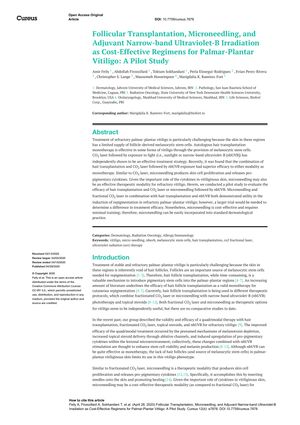
    Image of study
    TLDR Combining hair transplantation with microneedling or laser and UV light may help treat tough vitiligo on hands and feet, with microneedling being affordable and easy to learn.
    In a pilot study conducted to address the challenging treatment of palmar-plantar vitiligo, researchers evaluated the efficacy of combining hair transplantation with either CO2 laser or microneedling, followed by narrow-band ultraviolet-B (nbUVB) irradiation. Both combinations—hair transplantation with CO2 laser and nbUVB, as well as hair transplantation with microneedling and nbUVB—showed promise in inducing repigmentation in the difficult-to-treat areas of palmar-plantar vitiligo. However, the study suggested that a larger trial would be necessary to conclusively determine the difference in efficacy between the two treatment regimens. The study highlighted that microneedling, in particular, is cost-effective and requires minimal training, making it a viable option for standard dermatological practice.

    Discuss this study in the Community →

    Research cited in this study

    2 / 2 results

    Related Community Posts Join

    6 / 306 results

      community Occipitalis Muscle Tension Theory

      in Treatment  8 upvotes 3 weeks ago
      Scalp tension from the occipitalis muscle is theorized to contribute to hair loss, but most believe DHT and genetics are the main causes. Treatments like finasteride and minoxidil are considered more effective than addressing scalp tension.

      community Verteporfin and Microneedling

      in Treatments 1 year ago
      Clinical studies by Dr. Barghouthi and Dr. Bloxham indicate that Verteporfin, when used with FUE and FUT hair transplantation methods, shows promise in hair follicle regeneration and minimal scarring due to its ability to inhibit Yes-associated protein (YAP). Microneedling at depths of 3-3.5mm, combined with Verteporfin, could potentially reactivate dormant follicles, although the optimal dosage and application method are still under investigation. Concerns remain about the DHT sensitivity of regenerated follicles, highlighting the need for further research to optimize trauma levels and Verteporfin concentrations to achieve effective and scar-free hair regeneration.

      community A Theory on Why Microneedling Works

       170 upvotes 6 years ago
      Microneedling may enhance hair regrowth by transferring stem cells to dormant follicles, improving the effects of minoxidil. Users discuss using microneedling with needle lengths around 1.5mm to stimulate hair growth.

    Similar Research

    5 / 1000+ results