A Novel Fracture Lattice in Spiny Mouse Skin Facilitates Tissue Autotomy and Regeneration
March 2026
in “
bioRxiv (Cold Spring Harbor Laboratory)
”
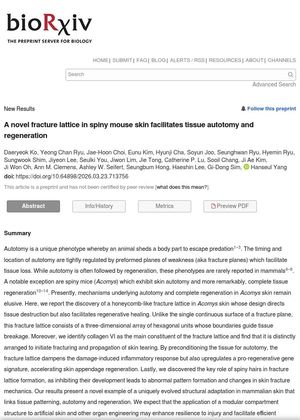
TLDR Spiny mice have a unique skin structure that helps them heal and regenerate quickly.
Researchers have discovered a unique honeycomb-like fracture lattice in the skin of spiny mice (Acomys) that facilitates both tissue autotomy and regeneration. This lattice, composed mainly of collagen VI, consists of a 3D array of hexagonal units that guide tissue breakage and promote regenerative healing. The structure preconditions the tissue for autotomy, reducing inflammation and enhancing a pro-regenerative gene signature, which accelerates skin appendage regeneration. Spiny hairs play a crucial role in the formation of this fracture lattice, as their inhibition leads to abnormal patterning and altered skin fracture mechanics. This study highlights a novel structural adaptation in mammalian skin that links tissue patterning, autotomy, and regeneration, with potential applications in artificial skin and organ engineering to improve resilience and regeneration.