TLDR Hair thickness decreases from the upper to lower areas of the back of the head, affecting hair transplant results.
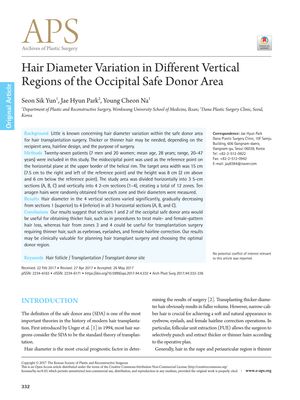
The study, involving 27 Korean participants (7 men and 20 women) with an average age of 28, examined hair diameter differences within the occipital safe donor area (SDA) for hair transplantation. The occipital area was divided into 12 zones, and measurements were taken from 10 anagen hairs in each zone. The results indicated a significant decrease in hair diameter from the upper to lower sections across all horizontal sections. The upper sections (1 and 2) were found to be suitable for harvesting thicker hair for treating male and female-pattern hair loss, while the lower sections (3 and 4) could provide thinner hair for surgeries requiring finer hair, such as eyebrow, eyelash, and female hairline correction. The study suggests using a combination of strip surgery and follicular unit extraction (FUE) to obtain the desired hair thickness for different parts of the hairline, with a strategic approach to donor hair selection being crucial for optimal hairline correction surgery outcomes.

2 citations
,
March 2017 in “Archives of Plastic Surgery” Intense pulsed light is a safe and effective way to thin hair for East Asians after hairline surgery.
16 citations
,
December 2016 in “Dermatologic Surgery” Higher scalp elasticity leads to wider scars after hair transplantation; a new method to measure elasticity may help predict scar size.
13 citations
,
September 2015 in “Aesthetic Surgery Journal” Transplanting hair from the nape and around the ear to the hairline and temples generally satisfies patients and looks natural.
11 citations
,
January 2015 in “Annals of Dermatology” Using a hair removal laser can make hairs finer for better hairline correction in hair transplants, with most patients happy and few side effects.
14 citations
,
May 2014 in “Archives of plastic surgery” The position of the parietal whorl can predict safe donor areas for hair transplants in Korean men with male pattern baldness.
24 citations
,
December 2011 in “Journal of The American Academy of Dermatology” Caucasian hair is denser, but Asian hair is thicker in female pattern hair loss patients.
83 citations
,
April 1999 in “Dermatologic Surgery” The research found that for a typical hair density, about 11 square centimeters of donor scalp is needed to get 800 hair grafts for transplantation.
January 2010 in “Elsevier eBooks” Hair transplantation is a treatment for hair loss mainly caused by genetics, with various techniques and potential complications, and results visible after 8-12 months.
1 citations
,
January 1998 in “Seminars in Plastic Surgery” Hair transplantation using micro- and minigraft megasessions is safe, effective, and provides natural results with high patient satisfaction.
7 citations
,
March 2020 in “Lasers in Medical Science” LLLT is a safe, promising hair loss treatment, but more research needed.
April 2025 in “Journal of Cosmetic and Laser Therapy” QR678 Neo® improves hair transplant success and hair regrowth.
January 2023 in “Journal of surgery and research” New treatment effectively reverses hair thinning in most patients with mild side effects.