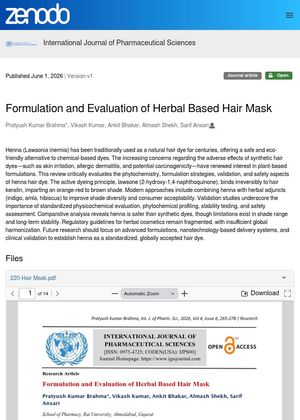
June 2026 in “Zenodo (CERN European Organization for Nuclear Research)” This review highlights the benefits of henna (Lawsonia inermis) as a natural and safer alternative to synthetic hair dyes, which can cause skin irritation and other health issues. Henna's active dyeing component, lawsone, binds to hair keratin, providing an orange-red to brown color. Combining henna with other herbs like indigo, amla, and hibiscus can enhance color variety and appeal. While henna is safer, it has limitations in shade range and stability. The review emphasizes the need for standardized evaluation and safety assessments, and suggests future research should explore advanced formulations and clinical validation to establish henna as a globally accepted hair dye. Regulatory guidelines for herbal cosmetics are currently inconsistent worldwide.

June 2026 in “Zenodo (CERN European Organization for Nuclear Research)” The study developed and evaluated a herbal hair mask using natural ingredients like flaxseed, fenugreek, aloe vera, and hibiscus, aiming to provide a safer alternative to synthetic hair products. Two formulations (F1 and F2) were tested for properties such as odor, texture, pH, spreadability, stability, and skin irritation. The results showed that the formulations had a pleasant odor, smooth texture, and suitable pH for scalp application, with no significant changes under various storage conditions, indicating good stability. The skin irritation test confirmed the formulations were non-irritant and safe for topical use. The herbal hair mask effectively conditioned, moisturized, and showed potential anti-dandruff and hair-strengthening properties, concluding it as a safe, stable, and effective natural option for healthy hair maintenance.
January 2024 in “Journal of pharmacognosy and phytochemistry” The herbal hair mask made from natural ingredients is safe, effective, and affordable for hair care.
May 2026 in “International Journal of Innovative Science and Research Technology (IJISRT)” This review discusses the formulation and evaluation of a multipurpose herbal hair mask using natural ingredients such as Emblica officinalis, Azadirachta indica, Trigonella foenum-graecum, and Hibiscus rosa-sinensis. It highlights the benefits of herbal hair masks over synthetic formulations, including nourishment, conditioning, dandruff control, and hair growth promotion. The review covers various preparation techniques and evaluation parameters, such as organoleptic, physicochemical, phytochemical, microbiological, and stability studies, emphasizing the synergistic effects of herbal ingredients in enhancing hair health while reducing adverse effects.