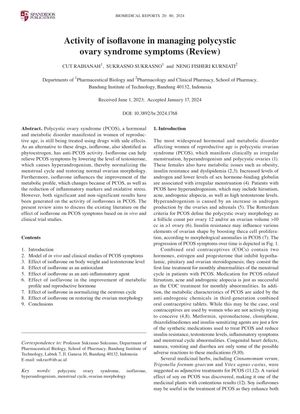
TLDR Isoflavone may help manage PCOS symptoms, but its effectiveness is uncertain.
Isoflavone, a phytoestrogen, shows potential in managing polycystic ovary syndrome (PCOS) symptoms by lowering testosterone levels, normalizing menstrual cycles, and improving ovarian morphology. It also positively affects the metabolic profile and reduces inflammatory markers and oxidative stress. However, the results on its efficacy are mixed, with both significant and non-significant outcomes reported. This review discusses the existing literature on isoflavone's effects on PCOS symptoms based on in vivo and clinical trial studies.
 49 citations
,
November 2019 in “Egyptian Journal of Medical Human Genetics”
49 citations
,
November 2019 in “Egyptian Journal of Medical Human Genetics” Certain gene variants may contribute to high androgen levels in women with polycystic ovary syndrome.
 30 citations
,
August 2019 in “Medical Sciences”
30 citations
,
August 2019 in “Medical Sciences” Androgens play a key role in causing PCOS (Polycystic Ovary Syndrome).
 18 citations
,
May 2017 in “Fertility Research and Practice”
18 citations
,
May 2017 in “Fertility Research and Practice” Larger ovarian size is linked to higher insulin resistance in women with PCOS.
 26 citations
,
June 2016 in “Journal of Reproductive Immunology”
26 citations
,
June 2016 in “Journal of Reproductive Immunology” Women with PCOS have higher xanthine oxidase activity linked to inflammation and heart disease risks.
 20 citations
,
January 2016 in “Open Journal of Endocrine and Metabolic Diseases”
20 citations
,
January 2016 in “Open Journal of Endocrine and Metabolic Diseases” PCOS affects fertility and is linked to obesity and menstrual irregularities; lifestyle changes are recommended for treatment.
 27 citations
,
January 2013 in “Indian Journal of Dermatology, Venereology and Leprology”
27 citations
,
January 2013 in “Indian Journal of Dermatology, Venereology and Leprology” PCOS is a complex disorder managed by treating symptoms and requires a team of specialists.
 4025 citations
,
December 2003 in “Human Reproduction”
4025 citations
,
December 2003 in “Human Reproduction” The 2003 consensus updated PCOS diagnosis criteria and linked PCOS to higher risks of diabetes and heart problems, recommending lifestyle changes to lower these risks.