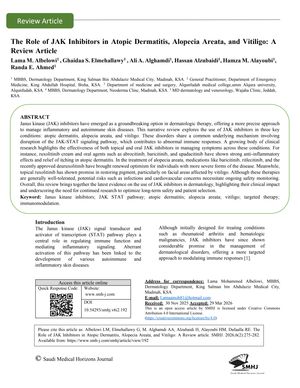
The Role of JAK Inhibitors in Atopic Dermatitis, Alopecia Areata, and Vitiligo: A Review Article
June 2026
in “
Saudi Medical Horizons Journal
”
TLDR JAK inhibitors show promise in treating skin conditions like eczema, hair loss, and vitiligo but need more safety research.
Janus kinase (JAK) inhibitors are a promising treatment for inflammatory and autoimmune skin diseases like atopic dermatitis, alopecia areata, and vitiligo, due to their ability to target the disrupted JAK-STAT signaling pathway. Clinical research supports the effectiveness of both topical and oral JAK inhibitors, such as ruxolitinib cream and oral agents like abrocitinib, baricitinib, and upadacitinib, in reducing inflammation and itching in atopic dermatitis. For alopecia areata, baricitinib, ritlecitinib, and deuruxolitinib offer hope for severe cases. In vitiligo, topical ruxolitinib shows potential in restoring facial pigment. While generally well-tolerated, these treatments require ongoing safety monitoring due to risks like infections and cardiovascular issues. The review emphasizes the need for further research to enhance long-term safety and patient selection.