Local Flaps of the Head and Neck
January 2010
in “
Elsevier eBooks
”
local flaps reconstructive surgery skin grafts composite grafts rotational flaps advancement flaps Z-plasty W-plasty nerve block aesthetic units muscle functions Abbe flap Karapandzic flap Webster modification Bernard-Burow cheiloplasty hair-bearing skin restoration orbicularis oris sphincter submental myocutaneous flap latissimus dorsi muscle flap submental flap latissimus dorsi flap
TLDR The document concludes that local flaps are effective for reconstructive surgery in the head and neck, offering good skin match and function.
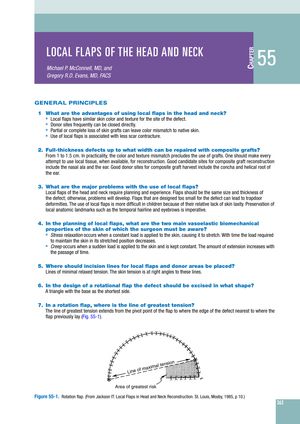
The document from 2010 provides a comprehensive overview of local flap techniques for reconstructive surgery in the head and neck region. It emphasizes the benefits of local flaps, such as better skin color and texture match and reduced scarring compared to skin grafts. The document explains that full-thickness defects up to 1 to 1.5 cm can be repaired with composite grafts and discusses the importance of precise planning and maintaining anatomic landmarks in flap surgery. It details various flap designs, including rotational and advancement flaps, and techniques like Z-plasty and W-plasty for scar revision. The survivability of flaps is linked to the perfusion pressures of the supplying vessels rather than the length-to-width ratio. The document also covers specific reconstruction techniques for the forehead, lips, and cheek, including nerve block locations, aesthetic units, and muscle functions. It concludes with flap techniques for lip reconstruction, such as the Abbe and Karapandzic flaps, and describes the Webster modification of the Bernard-Burow cheiloplasty for lip defects. Additionally, it discusses options for hair-bearing skin restoration and the importance of restoring the orbicularis oris sphincter for oral competence. The document classifies head and neck defects and describes various flaps like the submental myocutaneous flap and the latissimus dorsi muscle flap, each with specific indications for use.