Modified S Pattern for Scalp Reduction

    Craig S. Schauder, Dowling B. Stough, Thomas P. Chu
    Image of study
    TLDR The modified S pattern for scalp reduction is effective for removing more bald scalp and hiding scars in hair restoration.
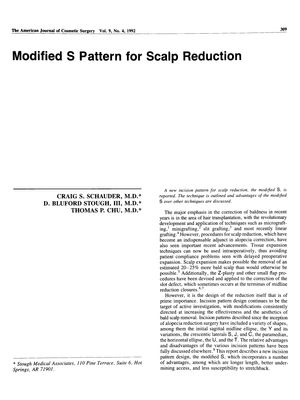
    The document reports on a new incision pattern for scalp reduction, the modified S, which has been used in over 30 cases over the course of approximately one year. This pattern is designed to improve the effectiveness and aesthetics of bald scalp removal. The modified S pattern is characterized by a small tight curve anteriorly and a looser, more sweeping curve posteriorly, which allows for the removal of more bald scalp per procedure, easier undermining, and better scar concealment. The pattern also distributes tension more widely, potentially reducing the tendency toward stretchback. The authors argue that scalp reduction, particularly with this new pattern, should be the procedure of choice for patients with vertex alopecia and, when combined with hair transplantation, offers excellent hair restoration. Results from the cases show marked improvements in patients with extensive alopecia, with the pattern allowing for a greater amount of bald scalp to be removed and the scar to be camouflaged effectively.

    Discuss this study in the Community →

    Research cited in this study

    2 / 2 results

    Related Community Posts Join

    6 / 1000+ results

    Similar Research

    5 / 1000+ results
      Philosophy and Technique in Hair Restoration Surgery

      research Philosophy and Technique in Hair Restoration Surgery

      3 citations , July 1997 in “Current problems in dermatology”
      Hair restoration surgery has evolved over time, with a focus on natural-looking results and managing patient expectations, while also considering potential complications and the lifelong progression of male pattern baldness.
      Advances in Hair Restoration Surgery

      research Advances in Hair Restoration Surgery

      10 citations , December 1997 in “Plastic and Reconstructive Surgery”
      Hair restoration surgery has improved with better techniques for natural looks and managing patient expectations, but it remains labor-intensive and requires careful consideration of potential complications.
      Planning for Maximum Coverage in Surgical Hair Restoration

      research Planning for Maximum Coverage in Surgical Hair Restoration

      3 citations , February 1996 in “Dermatologic Surgery”
      Walter P. Unger suggests using advanced hair transplant techniques for broader coverage, as they provide natural results and use donor tissue efficiently, while also recommending personalized planning due to the unpredictable progression of baldness.