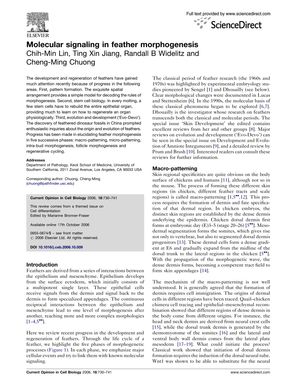
TLDR Feather growth and regeneration involve complex patterns, stem cells, and evolutionary insights.
The document discussed significant advancements in understanding feather development and regeneration, focusing on three main areas: pattern formation, stem cell biology, and evolutionary development. It highlighted the importance of decoding morphogenesis rules through spatial arrangement, the role of stem cells in regenerating epithelial organs during molting, and the evolutionary insights gained from feathered dinosaur fossils. Feather morphogenesis was elucidated in five phases: macro-patterning, micro-patterning, intra-bud morphogenesis, follicle morphogenesis, and regenerative cycling.
 25 citations
,
September 2006 in “Birth Defects Research”
25 citations
,
September 2006 in “Birth Defects Research” Different processes create patterns in skin and things like hair and feathers.
 16 citations
,
January 2005 in “The International Journal of Developmental Biology”
16 citations
,
January 2005 in “The International Journal of Developmental Biology” Hex gene plays a crucial role in starting feather development in chick embryos.
29 citations
,
December 2004 in “Developmental biology” cDermo-1 causes dense skin, feathers, and scales in chickens.
 23 citations
,
December 2004 in “Differentiation”
23 citations
,
December 2004 in “Differentiation” Sex hormones affect hair and feather growth and may help manage alopecia and hormone-dependent cancers.
66 citations
,
June 2004 in “Development” FGF signaling is crucial for starting feather development in chicken embryos.
112 citations
,
January 2004 in “The International journal of developmental biology” Feather patterns form through genetic and epigenetic controls, with cells self-organizing into periodic patterns.
75 citations
,
January 2003 in “Journal of Investigative Dermatology”