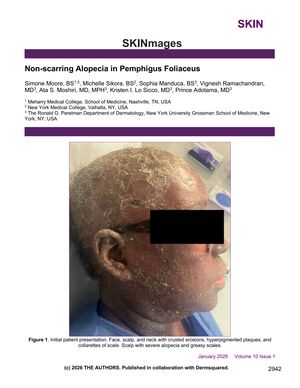
TLDR Rituximab treatment led to complete hair regrowth and improved skin in a woman with pemphigus foliaceus.
This case report discusses a 61-year-old African American woman with pemphigus foliaceus (PF), an autoimmune blistering disease, who presented with severe non-scarring alopecia and skin lesions. Despite initial treatment with mycophenolate mofetil and prednisone, her condition did not improve, leading to the introduction of intravenous rituximab. This treatment resulted in significant improvement of skin lesions and complete hair regrowth after 12 months. The study highlights the importance of recognizing alopecia as a significant, though rare, complication of PF, which can profoundly affect patients' quality of life. The sparing of the hair follicle bulge area from antibodies may explain the potential for hair regrowth post-treatment. Regular scalp evaluations are recommended for early detection and intervention.

58 citations
,
January 2018 in “International Journal of Women's Dermatology” Alopecia significantly lowers women's quality of life, with psychological and social challenges, highlighting the importance of early treatment and support.
13 citations
,
January 2018 in “BioMed Research International” Scalp involvement is common in pemphigus and can lead to hair loss, with the severity of scalp lesions linked to overall disease severity.
59 citations
,
June 2022 in “Frontiers in medicine” There are still challenges in diagnosing and treating chronic skin diseases, but there is hope for future improvements.
15 citations
,
January 2022 in “Immune Network/Immune network” New targeted immunotherapies are improving treatment for inflammatory skin diseases.
1 citations
,
January 2021 in “Journal of the Dermatology Nurses’ Association” The convention discussed various skin conditions and treatments, and highlighted the importance of vaccinations for patients on immune-altering medications.
January 2017 in “Springer eBooks” The document explains various skin conditions and their treatments.
2 citations
,
January 2004 in “Elsevier eBooks” Lupus affects the skin in various ways, and proper skin examination is crucial for diagnosis and treatment.