Pink1 Deficiency Rewires Early Immune Responses in a Mouse Model of Parkinson’s Disease Triggered by Intestinal Infection
May 2025
in “
npj Parkinson s Disease
”
TLDR PINK1 is important for controlling gut immune responses linked to early Parkinson's disease.
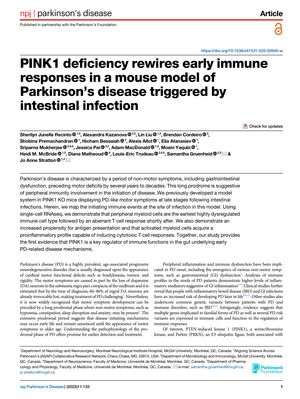
This study investigates the role of PINK1 deficiency in early immune responses in a mouse model of Parkinson's disease (PD) triggered by intestinal infection. The researchers used PINK1 knockout mice, which exhibit PD-like motor symptoms, to map immune events at the infection site. Single-cell RNA sequencing revealed that peripheral myeloid cells are the first to show significant dysregulation, followed by an abnormal T cell response. The study found that these myeloid cells have an increased tendency for antigen presentation and develop a proinflammatory profile that can induce cytotoxic T cell responses. The findings suggest that PINK1 is crucial in regulating gut immune functions, contributing to early PD-related disease mechanisms.