Transcriptional Profiling in Rat Hair Follicles Following Simulated Blast Insult: A New Diagnostic Tool for Traumatic Brain Injury

    August 2014 in “ PLoS ONE
    Jing Zhang, Lisa Carnduff, Grant Norman, Tyson Josey, Yushan Wang, Thomas W. Sawyer, Christopher J. Martyniuk, Valérie S. Langlois
    Image of study
    TLDR Hair follicles can help diagnose traumatic brain injury quickly and non-invasively.
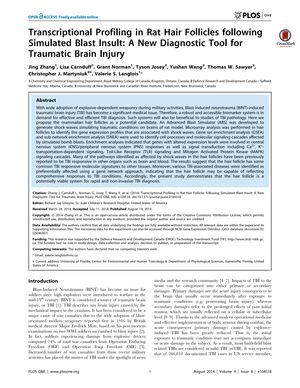
    The study explored the potential of using mammalian hair follicles as a diagnostic tool for traumatic brain injury (TBI) by simulating blast conditions on rat models. An Advanced Blast Simulator was used to create shock waves, and microarray analysis of hair follicles identified gene expression changes linked to these conditions. The analysis revealed that genes involved in CNS/PNS responses and various signaling pathways, such as Ca2+, K+-transportation, Toll-Like Receptor, and MAPK signaling, were affected. These pathways were previously associated with TBI in other tissues like the brain and blood. The findings suggested that hair follicles share TBI-responsive molecular signatures with other tissues, indicating their potential for non-invasive and rapid TBI diagnosis.

    Discuss this study in the Community →

    Research cited in this study

    5 / 5 results

    Related Community Posts Join

    6 / 1000+ results

      community Dht kills hair, but no one says why?

      in Finasteride/Dutasteride  40 upvotes 5 months ago
      DHT affects hair follicles, contributing to hair loss, but the exact mechanism is unclear. Treatments like finasteride and minoxidil are used to manage hair loss, though they may have side effects and varying effectiveness.

      community A Theory on Why Microneedling Works

       170 upvotes 6 years ago
      Microneedling may enhance hair regrowth by transferring stem cells to dormant follicles, improving the effects of minoxidil. Users discuss using microneedling with needle lengths around 1.5mm to stimulate hair growth.

      community Verteporfin and Microneedling

      in Treatments 1 year ago
      Clinical studies by Dr. Barghouthi and Dr. Bloxham indicate that Verteporfin, when used with FUE and FUT hair transplantation methods, shows promise in hair follicle regeneration and minimal scarring due to its ability to inhibit Yes-associated protein (YAP). Microneedling at depths of 3-3.5mm, combined with Verteporfin, could potentially reactivate dormant follicles, although the optimal dosage and application method are still under investigation. Concerns remain about the DHT sensitivity of regenerated follicles, highlighting the need for further research to optimize trauma levels and Verteporfin concentrations to achieve effective and scar-free hair regeneration.

    Similar Research

    5 / 1000+ results