Refining Hair Restoration Technique
March 2002
in “
Aesthetic Surgery Journal
”
TLDR In 2002, hair restoration improved by using a different area for grafts and absorbable sutures, leading to less discomfort and better results.
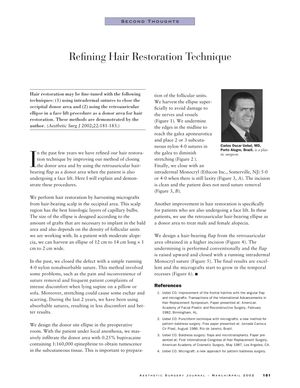
In 2002, hair restoration techniques were refined by improving the method of closing the occipital donor area and using the retroauricular hair-bearing flap as a donor area when the patient was also undergoing a face lift. The occipital area was chosen for harvesting micrografts due to its superior histologic layers of capillary bulbs. The size of the ellipse was designed according to the amount of grafts needed and the density of follicular units. Previously, a simple running 4-0 nylon nonabsorbable suture was used to close the defect, but this caused discomfort and scarring. In the last two years leading up to 2002, absorbable sutures were used, resulting in less discomfort and better results. For patients undergoing a face lift, the retroauricular hair-bearing ellipse was used as a donor area to treat alopecia. The final results were excellent, with the micrografts starting to grow in the temporal recesses.