Canonical and Emerging Regulatory Mechanisms of Tissue Remodeling: Shared Principles Across Organs and Therapeutic Opportunities
June 2026
in “
Frontiers in Immunology
”
TLDR Understanding tissue remodeling can help create precise treatments for various organ issues.
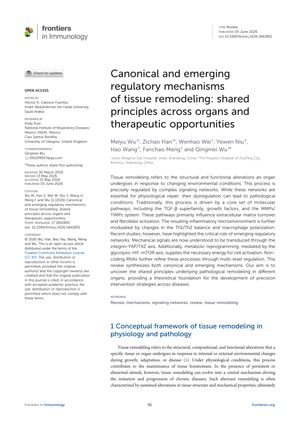
Tissue remodeling involves structural and functional changes in organs, regulated by complex signaling networks. Canonical pathways like the TGF-β superfamily, growth factors, and the MMPs/TIMPs system are crucial for extracellular matrix turnover and fibroblast activation, influencing the inflammatory microenvironment. Recent insights reveal the importance of mechanical signals via the integrin-YAP/TAZ axis and metabolic reprogramming through the glycolysis-HIF-mTOR axis, which provide energy for cell activation. Non-coding RNAs also play a significant role in refining these processes. This review integrates both traditional and new mechanisms to identify shared principles of pathological remodeling across organs, aiming to support the development of precision therapeutic strategies.