TLDR Ritlecitinib is safe and well-tolerated for treating alopecia areata in patients aged 12 and older.
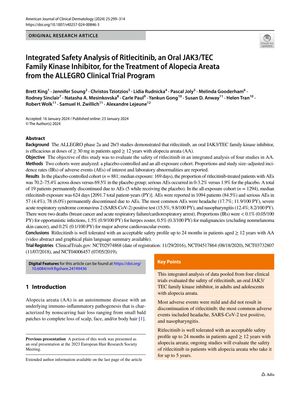
The integrated safety analysis of ritlecitinib, an oral JAK3/TEC family kinase inhibitor, for treating alopecia areata (AA) in patients aged ≥ 12 years, demonstrated that the drug is well tolerated with an acceptable safety profile up to 24 months. In the placebo-controlled cohort (n = 881), adverse events (AEs) were reported in 70.2–75.4% of ritlecitinib-treated patients compared to 69.5% in the placebo group, with serious AEs occurring in 0-3.2% versus 1.9% for placebo. In the all-exposure cohort (n = 1294), AEs were reported in 84.5% of patients, with serious AEs in 4.4% and 6.0% discontinuing due to AEs. Common AEs included headache, SARS-CoV-2 positive test, and nasopharyngitis. There were two deaths and low incidence rates for opportunistic infections, herpes zoster, malignancies, and major adverse cardiovascular events.
51 citations
,
July 2023 in “American Journal of Clinical Dermatology”  1 citations
,
June 2023 in “Dermatology and therapy”
1 citations
,
June 2023 in “Dermatology and therapy” People with Alopecia Areata have more herpes simplex infections but similar rates of cancer, blood clots, and heart disease compared to those without it.
227 citations
,
April 2023 in “The Lancet” Ritlecitinib effectively treats alopecia areata and is well-tolerated.
 25 citations
,
November 2022 in “British journal of dermatology/British journal of dermatology, Supplement”
25 citations
,
November 2022 in “British journal of dermatology/British journal of dermatology, Supplement” Baricitinib for severe alopecia areata is generally safe, with common side effects like infections and acne, and low rates of serious complications.
 148 citations
,
March 2022 in “The New England Journal of Medicine”
148 citations
,
March 2022 in “The New England Journal of Medicine” Baricitinib was effective in treating alopecia areata in two major trials.
 67 citations
,
March 2021 in “Dermatology and Therapy”
67 citations
,
March 2021 in “Dermatology and Therapy” Alopecia areata greatly harms quality of life, causing emotional and social issues.
138 citations
,
March 2021 in “Journal of the American Academy of Dermatology” Ritlecitinib and brepocitinib effectively regrow hair in alopecia areata patients.
 95 citations
,
November 2018 in “Australasian journal of dermatology”
95 citations
,
November 2018 in “Australasian journal of dermatology” Alopecia areata treatment varies, with no optimal method established yet.
162 citations
,
October 2014 in “Autoimmunity reviews” Alopecia areata is caused by the immune system attacking hair follicles.
 164 citations
,
April 2008 in “Cochrane library”
164 citations
,
April 2008 in “Cochrane library” Current treatments for alopecia show no significant long-term benefits.