Susan Lee Lindquist (1949–2016)—Pioneer in the Study of Cellular Protein Folding and Disease

    December 2016 in “ EMBO journal
    F. Ulrich Hartl
    Image of study
    TLDR Susan Lee Lindquist was a pioneering biologist who made significant contributions to understanding protein folding and its role in disease.
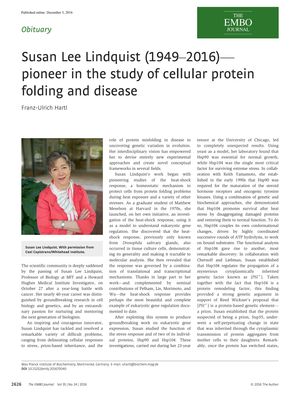
    Susan Lee Lindquist, a renowned biologist at MIT and a Howard Hughes Medical Institute Investigator, passed away on October 27 after a year-long battle with cancer. Her nearly 40-year career featured pioneering research in cell biology and genetics, particularly in the study of cellular protein folding and its implications for disease. Lindquist's early work as a graduate student at Harvard led to significant insights into the heat-shock response, a cellular defense mechanism against protein misfolding. She discovered that this response was a universal eukaryotic gene regulation mechanism. Her subsequent research at the University of Chicago uncovered the critical roles of the proteins Hsp90 and Hsp104 in cellular growth and stress survival, respectively. Lindquist's work also contributed to the understanding of prions, protein-based genetic elements, and their role in inheritance and disease. Later, her research at the Whitehead Institute focused on molecular chaperones and stress response pathways in neurodegenerative diseases and cancer, leading to potential new therapeutic strategies. Lindquist was a passionate mentor and advocate for science, leaving behind a legacy of successful students and postdocs. She received numerous prestigious awards and was a member of several esteemed scientific societies. Her passing is a significant loss to the scientific community.

    Discuss this study in the Community →

    Related Community Posts Join

    6 / 125 results

      community Journey against alopecia - Finasteride 3 month

      in Progress Pictures  17 upvotes 4 years ago
      A 26-year-old man from France started experiencing hair loss in September 2020 and began using finasteride in June 2021, reporting some improvement after three months without side effects. He plans to continue finasteride for a year before considering additional treatments like minoxidil or dermarolling.

      community My Theory Of Androgenic Alopecia

      in Research/Science  21 upvotes 3 months ago
      Hair loss is linked to cellular physiology and the IGF-1 to TGF-B1 ratio, not just androgen sensitivity. The theory lacks evidence, while finasteride and minoxidil are effective treatments.

      community Hey med experts explain this please??

      in Research/Science  5 upvotes 5 months ago
      Finasteride, dutasteride, saw palmetto, caffeine, spironolactone, acetyltetrapeptides, tea tree oil, hydrocortisone, zinc pyrithione, latanoprost, melatonin, marine protein supplements, PRP, microneedling, and valproate are discussed as treatments for hair loss. DHT reduction and inflammation control are key strategies.

      community Does anyone have a list of vitamins that could help alongside dut and min?

      in Treatment  7 upvotes 1 week ago
      The conversation is about hair loss treatments, specifically using dutasteride and oral minoxidil, and exploring additional vitamins and supplements like vitamin D, zinc, biotin, and omega-3 to support hair health. Users suggest getting a blood panel to identify deficiencies and emphasize the importance of protein and overall nutrition.

    Similar Research

    5 / 1000+ results