TLDR Certain immune cells in the skin release a protein that stops hair growth by keeping hair stem cells inactive.
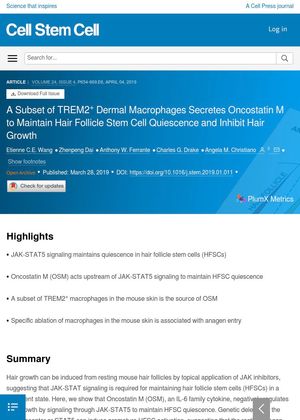
In 2019, researchers discovered that a subset of TREM2+ dermal macrophages, also known as trichophages, secrete Oncostatin M (OSM), a cytokine that inhibits hair growth by keeping hair follicle stem cells (HFSCs) in a resting state. This is achieved through the OSM-OSMRβ-STAT5 signaling pathway. When these macrophages were removed, hair growth and HFSC activation occurred. Genetic deletion of the OSM receptor or STAT5 also led to premature HFSC activation, indicating that the resting stage of hair growth is actively maintained by the hair follicle niche. The study suggests that manipulating this pathway could potentially regulate hair growth.

TDM-105795 showed promising hair growth results, with higher efficacy than placebo and minimal side effects. It activates dormant hairfolliclestem cells and may maintain gains without immediate loss, unlike minoxidil.
Hairfollicles are mostly dormant but can be reactivated with treatments like minoxidil, finasteride, and microneedling. A new drug, PP405, shows promise for hair regrowth but may not be available until 2027-2028.
Fatty acid metabolic signaling can activate epithelial stem cells for hair regeneration. Oleic and palmitoleic acids showed the best results, but practical application on humans remains uncertain.
Hair regrowth treatments, including stem cell injections, are discussed, with skepticism about their effectiveness compared to Minoxidil and finasteride. Derma stamping is mentioned as effective when used with Minoxidil, finasteride, and dutasteride.
Finasteride, Minoxidil, Bioneer CosmeRNA, Technoderma, Kintor, Hope, Breezula, and Follicum treatments showed increases in hair count, with Technoderma showing the highest increase at 24.3 hairs/cm². Amplifica has not yet published results.