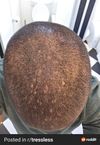
TLDR Trichotillomania shows specific signs like black dots and uneven hair lengths but lacks certain features of alopecia areata.
The document discusses trichotillomania, a type of traction alopecia caused by repetitive hair pulling, and its trichoscopic features. It highlights that trichotillomania can sometimes be clinically and dermoscopically similar to patchy alopecia areata. Key trichoscopic signs of trichotillomania include black dots, coiled or hook hairs, hair shafts of varying lengths with frayed or split ends (known as trichoptilosis), and notably, the absence of exclamation mark hairs and yellow dots, which are typically seen in alopecia areata.
 89 citations
,
March 2018 in “The Journal of Dermatology”
89 citations
,
March 2018 in “The Journal of Dermatology” Trichoscopy helps diagnose and monitor alopecia areata by looking at a combination of specific hair and scalp features.
 37 citations
,
January 2017 in “International Journal of Dermatology”
37 citations
,
January 2017 in “International Journal of Dermatology” Trichoscopy helps tell apart alopecia areata and trichotillomania in Asians by looking at specific hair and scalp features.
 26 citations
,
September 2016 in “International Journal of Dermatology”
26 citations
,
September 2016 in “International Journal of Dermatology” Trichoscopy is good for telling apart tinea capitis and alopecia areata in kids.
 245 citations
,
March 2012 in “Journal of The American Academy of Dermatology”
245 citations
,
March 2012 in “Journal of The American Academy of Dermatology” Dermatoscopy is useful for identifying different hair and scalp conditions and can reduce the need for biopsies.
 304 citations
,
July 2006 in “Journal of The American Academy of Dermatology”
304 citations
,
July 2006 in “Journal of The American Academy of Dermatology” Videodermoscopy improves diagnosis of hair and scalp disorders and may reduce scalp biopsies.