TLDR Wedelolactone may help treat inflammation, infections, cancer, bone loss, and organ damage.
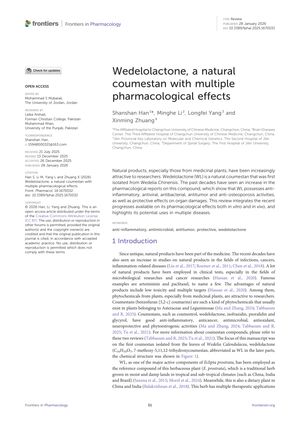
Wedelolactone (WL), a natural coumestan derived from Wedelia Chinensis, has garnered significant research interest due to its diverse pharmacological effects. Recent studies have demonstrated that WL exhibits anti-inflammatory, antiviral, antibacterial, antitumor, and anti-osteoporosis activities, alongside protective effects against organ damage. This review compiles the latest findings on WL's pharmacological properties observed in both in vitro and in vivo studies, underscoring its potential therapeutic applications in various diseases.
 1 citations
,
March 2024 in “Signal transduction and targeted therapy”
1 citations
,
March 2024 in “Signal transduction and targeted therapy” NF-κB signaling is crucial in many diseases and can be targeted for new treatments.
6 citations
,
October 2023 in “Pharmaceuticals” Eclipta prostrata extract may help with memory and diabetes due to its antioxidant and enzyme-inhibiting properties.
6 citations
,
June 2022 in “Journal of Orthopaedic Surgery and Research” Wedelolactone may help reduce bone loss with fewer side effects.
58 citations
,
March 2019 in “Frontiers in Pharmacology” Wedelolactone may help treat lung fibrosis by reducing inflammation and lung damage.
53 citations
,
November 2014 in “International Journal of Oncology” Wedelolactone may help prevent bone damage in breast cancer by blocking certain cell signals.
 49 citations
,
October 2014 in “International Scholarly Research Notices”
49 citations
,
October 2014 in “International Scholarly Research Notices” Eclipta alba has many health benefits and contains compounds with potential for drug development.
83 citations
,
October 2012 in “International Journal of Oncology” Wedelolactone selectively kills prostate cancer cells without harming normal cells.
 98 citations
,
May 2008 in “Archives of Dermatological Research”
98 citations
,
May 2008 in “Archives of Dermatological Research” Eclipta alba extract helps hair grow faster and more effectively than minoxidil in rats.