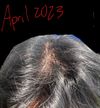
A 27-year-old Asian male is treating hair loss with 1mg oral finasteride, topical minoxidil twice daily, and 1.5mm microneedling weekly. The discussion is about his progress with these treatments.
ShaneMorcs shared updated hair comparison photos and believes he's made progress. People commented on his improvement, asked about potential side effects, and inquired about the treatments he's using.
The conversation is about men discussing their experiences with hair loss and their acceptance or resistance to it, mentioning treatments like finasteride and hair transplants. Some users express hope to maintain their hair while young, while others have accepted baldness or found confidence after shaving their heads.
The conversation discusses the effectiveness of combining Laminaria japonica and Cistanche tubulosa extracts for hair growth. It also mentions treatments like Minoxidil, finasteride, and RU58841.
The user experienced significant hair regrowth over five months using Locklabs oral tablets, with no side effects and only a minor shed. They dye their hair black to cover natural blonde, which may affect perceived hair density.
The conversation questions the lack of feedback on the effectiveness of PGE2 and setipiprant for hair loss, despite their availability. The user is puzzled by the absence of reviews or results, whether positive or negative.
Kintor Pharmaceutical's Phase 2 results with the drug Pyrilutamide, a potential alternative to 5-ARI drugs like Finasteride and Dutasteride but without the side effects. It could be used in combination with other topical treatments such as Minoxidil. The safety of the drug has been demonstrated in 6 months of use, however there are still questions about long term efficacy and systemic absorption.
The conversation is about a user assessing their hair loss as Norwood 1.5 and discussing their use of oral minoxidil and finasteride for 2.5 years, which improved their hair density. They are content with their current progress but hope to reach Norwood 1.
Injectable GHK-CU and BPC157 were discussed for hair loss, but users did not notice significant hair changes. BPC157 was noted to help with shoulder issues.
Chinese company gets green light for Pyrilutamide Phase II trial for androgenetic alopecia. Androgen receptors downregulate in androgen deficient environments.
User found 15% procyanidin B2 supplement and asks if it's legit. Recommended dosage is 400-600mg daily, similar to study, and user wonders if it's effective for hair loss.
The conversation is about a person rapidly losing hair and seeking information on the availability of a new treatment called scube3, as they have experienced side effects from current treatments like Minoxidil and finasteride. They are hoping scube3 will be approved soon as they believe it's their only remaining option.
Researchers are working on regenerating hair follicles using stem cells, but a cure for baldness is still years away. Current treatments mentioned include Minoxidil, finasteride, and RU58841.
The conversation discusses using ecklonia cava as a natural alternative to finasteride for hair loss. Users share their experiences and opinions on its effectiveness.
The conversation discusses a 20-year-old transgender female's one-year experience with hair loss treatments, including Estradiol HRT, oral Finasteride, Bicalutamide, and Cyproterone. Specific treatments used for hair loss are oral Finasteride and potentially Estradiol as part of hormone replacement therapy.
A new drug, PP405, is being discussed as a potential cure for baldness, with hopes it could be more effective than Minoxidil and Finasteride. Users are skeptical about its effectiveness and the need for lifelong use.
A 20-year-old male shared his 4-month hair regrowth results using finasteride, minoxidil, nizoral, and dermarolling. Commenters noted improved hair density and the potential for further progress.
The conversation discusses hair regrowth progress from Norwood scale 4 to 2.5 over a year using daily 8.5-9% RU58841, topical Dutasteride 0.1%, RU58841 5% 1.5 times a week, and daily caffeine redensyl scalp treatment.
The conversation discusses the safety study of PP405, emphasizing that early trials focus on safety rather than efficacy, and that any efficacy data from such a short study should be viewed skeptically. It also highlights that the information released is primarily for securing funding, and that meaningful efficacy results are expected in later phases.
Hair loss discussion with a focus on a single resilient hair, jokingly called "chad hair," that remains despite hairline receding. Some users suggest microneedling and hair follicle cloning as potential treatments.
A user shared a video suggesting that 0.5mm microneedles are most effective for hair growth. Other users mentioned different microneedle lengths and advised consulting a dermatologist for personalized treatment.
A 20-year-old male is experiencing worsening diffuse thinning despite using topical minoxidil, topical finasteride with minoxidil, oral finasteride, stemoxydine, and pyrilutimide. He is seeking support and advice as he struggles with the mental and physical challenges of hair loss treatments.
A humorous discussion about random, long hairs appearing on the body, with no connection to hair loss treatments like Minoxidil, finasteride, or RU58841. Participants share personal anecdotes about these unusual hairs.
The user is 10 days post-hair transplant, pleased with the results so far, and hopes for increased density. The procedure was done at Vanity Hospital in Istanbul, with around 3400-3750 grafts used.
The conversation discusses the potential for developing a biologic "DHT sponge" to neutralize DHT in the bloodstream as a treatment for hair loss, suggesting it could be more targeted and have fewer side effects than current treatments like finasteride and dutasteride. Concerns include the complexity, cost, and potential side effects of such a treatment, as well as skepticism about its feasibility and market interest.
Finasteride worked better for frontal scalp hair loss, while dutasteride helped the crown and mid-scalp but worsened the frontal area. The user shared personal experiences and invited open dialogue.
Long term Finasteride users and whether or not they have noticed improvements after two years of use, with other treatments such as Minoxidil and dermarolling also discussed. Some replies suggest that improvement is possible even beyond the two year mark while others caution against believing studies backed by the Post-Finasteride Foundation.
The conversation is about frustration over the delay in phase 2 results for a hair loss treatment called GT20029. One user suspects the treatment may have failed.