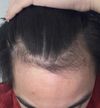
The conversation discusses using RU58841 mixed with topical minoxidil for hair loss, noting its chemical instability and storage challenges. A user shares their experience using RU58841 with ethanol and propylene glycol, mentioning no significant results yet.
The conversation is about choosing a topical antiandrogen for hair loss, with options including RU58841, CB0301, Pyrolutamide, Alfatradiol, and Fluridil. Users discuss their preferences and reasons for selecting specific treatments.
A 59-year-old man with significant hair loss has seen some improvement, including reversal of Retrograde Alopecia and darkening of hair, after switching to RU58841 and a new minoxidil base solution with additional ingredients. He also changed from a derma roller to a derma stamp for application.
The user shared their bloodwork results showing DHT at 17 ng/dl and testosterone at 287 ng/dl, with a slight Vitamin D deficiency. They are seeking opinions on these levels and have an upcoming dermatologist appointment.
The conversation is about using RU58841 for hair loss, discussing the stability of the powder form and the need for a carrier solution like KB or PG + ethanol. The user is advised to mix RU58841 with stemoxydine and store it properly, while also considering safety precautions.
The user has been using finasteride, minoxidil, a dermastamp, and red light therapy for six months with no visible improvement since the three-month mark. Other users noted improvement, particularly in the left temple area, and encouraged the user to continue.
The user is experiencing significant hair shedding after starting RU58841, despite using dutasteride and oral minoxidil for over a year without stabilization. Others suggest continuing the treatment as shedding can be a normal phase, but caution that RU58841 is unpredictable.
A human trial involving verteporfin for hair regeneration, with the results showing some regrowth of 1-2 hairs in an area where a follicular unit was extracted. The conversation also suggested that future studies should involve higher doses and more frequent injections.
People are discussing hair loss treatments, including pyrilutamide, minoxidil, dutasteride, alfatradiol, and bimatoprost. Users share their experiences and side effects, noting that pyrilutamide is considered more effective and safer than RU58841.
A user's success in hair regrowth after taking oral and topical medications, such as minoxidil and dutasteride, and using microneedling. Other users shared their experiences and advice with treatments used to reverse hair loss.
A user shared progress pictures showing improvement from NW 6 to NW 2 after four months of treatment. They are considering using exosomes to further reverse hair miniaturization.
The conversation humorously discusses hair loss treatments, mentioning Minoxidil, finasteride, and RU58841. It jokingly suggests the creation of a new chemical called RU99999.
The user is using a combination of oral Dutasteride and Minoxidil, and a topical formula with Finasteride, Minoxidil, and Hydrocortisone, along with rosemary oil, coconut oil, ginseng, and a derma roller. They are also using LLLT therapy and are questioning the timing of the laser cap session in relation to the topical application.
The conversation is about a user expressing concerns over the safety of a new drug called Pyrilutamide (also known as KX-826) for hair loss. The user will only trust the drug if it's permitted by EU regulations and sold by a reputable company.
Alfatradiol is discussed as a weak 5ARI and estrogen, not as effective as minoxidil, RU58841, or CB-03-01, but a safe alternative for those who can't use finasteride. Users express frustration over the lack of strong FDA-approved topical antiandrogens for hair loss.
Hair loss treatments discussed include alfatradiol, big 3, finasteride, RU58841, and stemoxydine. Alfatradiol is less effective but has fewer side effects, and mixing with stemoxydine may improve results.
Finasteride and Nizoral shampoo with Ketoconazole are used for hair loss treatment. Liquid Chromatography–Mass Spectrometry (LC-MS) is recommended over Enzyme-Linked Immunosorbent Assay (ELISA) for more accurate DHT testing.
The user reported significant hair improvement over 15 months using dutasteride, minoxidil (oral and topical), RU58841, ketoconazole, and microneedling. They are considering a hair transplant in 4-6 months.
The user added RU58841 to their finasteride and minoxidil routine, noticing significant improvement in hairline after 52 days. Some users warn about potential side effects of RU58841, while others express curiosity and congratulate the progress.
The conversation discusses hair regrowth progress using topical dutasteride with cetirizine, laser therapy, and growth serum. The user observes miniaturized, vellus hairs on the scalp.
A 17-year-old is experiencing rapid hair loss from NW1.5 to NW3 in six months and feels dermatologists are unhelpful. They are using Minoxidil (Rogaine) and seeking advice on application.
Minoxidilmax offering a 0.5% Pyrilutamide solution and debating the cost, effectiveness, and safety of using it alone or with other treatments such as Finasteride and Minoxidil.
RU58841 cured seborrheic dermatitis, oily scalp, dandruff, and scalp pain, improving hair health when combined with Minoxidil. Another user noted diet impacts their seborrheic dermatitis and that finasteride hasn't changed their condition.
The conversation is about the stability of pyrilutamide in different solutions. The user is asking if a 70/30 ethanol/pg solution with 4% water will degrade pyrilutamide.
A user shared their 3-month progress using RU58841, 10% minoxidil, and microneedling every two weeks for hair loss. They found the new minoxidil sprayer effective for applying the treatment across the scalp.
The user experienced hair regrowth using a combination of Minoxidil, Finasteride, and RU58841, with Minoxidil used initially and the other treatments added later. The user believes the combination of Finasteride and RU58841 contributed to the regrowth, with RU sourced from MVsupplement.