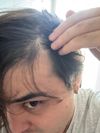
A drug that regrows body parts, but not hair, sparking debate on hair loss treatments. Discussions include the use of finasteride, dutasteride, and the potential for new methods to restore hair.
The user had been using Minoxidil and Dutasteride with micro-needling but experienced hair loss after switching Minoxidil brands. Their doctor prescribed oral Minoxidil and Tretinoin, but the pharmacist suggested isotretinoin might be a more cost-effective alternative.
A 21-year-old is experiencing hair thinning and is using oral finasteride and topical minoxidil, considering adding oral minoxidil. They are unsure if the condition is androgenetic alopecia (AGA) or telogen effluvium (TE) and are advised to continue treatments and get a blood test.
The user's experience of using Finasteride 5mg and Aldactone 50mg to treat Female Pattern Hair Loss, as well as their use of PRP injections for further hair growth.
The conversation discusses using GFM Gel, a topical gel with polypeptides that mimic growth factors to promote hair regrowth and strengthen hair. It also mentions treatments like Minoxidil, finasteride, and RU58841 for hair loss.
A 22-year-old is using a hair loss treatment protocol including dutasteride, microneedling, 10% minoxidil, 0.1% finasteride topical, a healthy diet, and a hair multivitamin. Users discuss the effectiveness of microneedling and the intensity of the treatment.
KX-826 (Pyrilutamide) 0.5% and 1.0% solutions showed promising results in increasing hair count for male androgenetic alopecia, with the 0.5% dose slightly outperforming the 1% dose. The treatment was well-tolerated with no sexual side effects, but skepticism remains due to past inconsistencies in trial results.
Sons are offering free Biotin capsules, Thickening Clay, or Conditioner for hair care testing to UK men. Interested individuals can apply to receive these products without purchase.
A 24-year-old with hair thinning is using a regimen including dutasteride, RU58841, HGH, GHK-cu, and other compounds to protect and regrow hair. They are also incorporating a mild cutting cycle with testosterone propionate, anavar, and tirzepatide.
Evidence-based treatments for androgenic alopecia, such as minoxidil, finasteride, low-level laser light therapy, dutasteride, platelet-rich plasma, and topical ketoconazole. It discusses the efficacy, safety, and mechanism of action of these treatments, as well as future developments in understanding this polygenic condition.
The user has been using a hair loss treatment protocol including topical dutasteride, minoxidil with tretinoin, ketoconazole shampoo, microneedling, a laser cap, and vitamin D for 15 weeks, showing impressive progress. Feedback suggests continuing medical therapy for 12-24 months before considering a hair transplant.
The conversation is about Kintor's announcement indicating continued hope for their product KX-826 as a treatment for Alopecia Androgenetica. Specific treatments mentioned are Minoxidil, Finasteride, and RU58841.
Finasteride is helping regrow hair in previously thinning areas, and the user plans to add minoxidil to enhance results. The user is considering increasing the finasteride dose to 1mg daily for better outcomes.
The user shared their hair loss journey, trying various methods like a hair system and scalp micropigmentation, and recently started using finasteride and minoxidil with supplements like biotin, zinc, and ketoconazole shampoo. Another user mentioned starting dutasteride and minoxidil with biotin and zinc.
The conversation discusses alternatives to 5AR inhibitors for hair loss treatment, suggesting options like minoxidil, KX-826, pyrilutimide, microneedling, and topical bicalutamide. Concerns about side effects and the effectiveness of these treatments are also highlighted.
Microneedling may enhance hair loss treatment by increasing the effectiveness of topical minoxidil, especially for those lacking the necessary enzyme to activate it. It might also work by triggering growth factors and improving topical absorption.
Topical aldactone is discussed for its effects on men's hair and muscles. The conversation explores its potential benefits and side effects compared to other treatments like Minoxidil, finasteride, and RU58841.
The conversation is about a hair loss treatment regimen that includes finasteride, dutasteride, oral minoxidil, Dermapen, quercetin, N-acetyl L-cysteine, biotin, millet seed extract, MSM, OPC, green tea extract, high-dose vitamins B1-B12, boron, and silica. The user is seeking advice on additional treatments.
The user experienced rapid diffuse hair thinning for five years despite no signs of AGA or miniaturization. They tried finasteride and oral minoxidil without success and have checked thyroid, iron, and vitamin D levels.
The conversation discusses anticipation for CB-03-01, a potential new hair loss treatment that may be more effective and have a cleaner safety profile than finasteride. Users are hopeful but cautious, discussing current treatments like minoxidil, nizoral, and dermarolling, and the possibility of combining them with CB-03-01 for better results.
Japanese scientists discovered ABM cells, enabling successful human hair follicle cloning, potentially curing hair loss. The treatment may be available in Japan by 2028, but it will be expensive and require travel.
Spironolactone, finasteride, and dutasteride are discussed for hair maintenance, with concerns about testosterone and side effects like gynecomastia. Spironolactone is noted for use in both bodybuilding and hormone therapy, with low doses considered for minimizing side effects.
The conversation is about a user seeking help with hair regrowth treatments, specifically mentioning Setipiprant, Minoxidil, Finasteride, and RU58841. The user is trying to contact forum members for guidance on making and using these treatments.
Betacarotene's effect on hair loss is discussed, with concerns about excessive vitamin A. The user also questions if 15mg melatonin impacts vitamin A levels.
The post and conversation are about skepticism towards HairClone's crowdfunding campaign for a hair loss cure, with users expressing doubt and calling it a scam. Specific treatments mentioned include Minoxidil, finasteride, and RU58841.
Shampoos, including those with aminexil, are generally ineffective for hair loss and are considered overpriced. Minoxidil and finasteride are more effective treatments.
The conversation discusses the difficulty of applying tretinoin 0.025% cream on the scalp and considers switching to a gel for easier application. It also mentions that a liquid solution, ideally combined with minoxidil, may be more effective for hair treatment.
The user has been using Minoxidil and finasteride for two years, which stopped their hair loss but did not regrow hair. They are inquiring if adding microneedling or tretinoin has provided benefits to others in similar situations.
Clascoterone 5% solution is not yet commercially available, with only the 1% solution currently sold for acne. Users discuss the potential of Clascoterone as a hair loss treatment, comparing it to other anti-androgens like RU58841 and Eucapil.