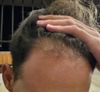
A 24-year-old male experiencing diffused thinning discusses his DHT levels and hair density issues. He has not used finasteride or dutasteride and is considering AR inhibitors.
A user experienced an allergic reaction, including swollen lymph nodes, to Minoxidil 5% with an aqueous base. Switching to a non-alcohol-based Minoxidil (Prolox 5%) resolved the allergies.
A user is considering starting spironolactone for androgenetic alopecia but is concerned about stopping it before pregnancy. Another user suggests trying topical treatments as an alternative.
A 20-year-old is considering switching from finasteride to dutasteride during a steroid cycle to better manage hair loss, then returning to finasteride afterward. They are concerned about the risks of post-finasteride syndrome from frequently changing medications.
A 39-year-old experienced hair regrowth on his temples after switching from finasteride to topical RU58841 combined with 5% minoxidil. He also underwent stem cell treatment and noticed improvements, attributing the regrowth mainly to the change in treatment.
The conversation is about considering pyrilutamide 1% as an alternative treatment for hair loss due to intolerance to 5-alpha reductase inhibitors. Some users suggest it might be effective, while others view it as a temporary solution.
The user is considering using RU58841 and pyrilutamide for hair loss, debating between powder and topical forms, and is currently using a combination of dutasteride, finasteride, minoxidil, tretinoin, and supplements. They report no significant side effects from finasteride and dutasteride, and are seeing some hair growth, but not on the scalp.
The user switched from oral to topical finasteride with minoxidil after a hair transplant and is experiencing increased hair growth in unexpected areas like eyebrows and sideburns. They are seeking feedback from others with similar experiences.
The user is seeking advice on improving their hairline, currently using dutasteride 0.5mg/day and oral minoxidil 5mg/day for 14 months. They want to avoid a hair transplant and are concerned about thin hair and receding temples.
Dutasteride at 0.5 mg/day does not significantly alter allopregnanolone levels, but higher doses (2.5 mg/day) do. Dutasteride may also have anti-neuroinflammatory effects, but the impact on neurosteroids is still debated.
The conversation discusses using cyproterone temporarily to reverse hair loss, followed by finasteride to maintain regrowth. Concerns about cyproterone's side effects, such as lowering testosterone and potential health risks, are raised, with alternatives like spironolactone suggested for androgen-related issues.
A 22-year-old is experiencing hair loss and anxiety, trying treatments like topical finasteride, rosemary oil, caffeine, microneedling, low-level laser therapy, scalp massages, ketoconazole shampoo, and various vitamins. They are concerned about potential gynecomastia and are considering using minoxidil if current treatments don't stop hair loss or promote regrowth.
The user has androgenetic alopecia (AGA) and low Vitamin D levels, and they started using topical minoxidil (5%). They are considering finasteride but are concerned about side effects and are advised to seek mental health support.
A user is experiencing hair loss despite using dutasteride and oral minoxidil, feeling hopeless and considering a hair system. They are advised to try ketoconazole, seek a second opinion from a dermatologist, and consider treatments like finasteride, RU58841, and hair transplants.
A 22-year-old's experience with receiving a hair transplant and the use of Minoxidil, finasteride, RU58841, Lidocaine shots, and platelet injections to treat hair loss.
A dermatologist refused to prescribe finasteride due to concerns about recent research linking it to male breast cancer, suggesting a topical alternative with minoxidil instead. The user is advised to seek a second opinion, as the evidence for such risks is inconclusive and the dermatologist's reasoning seems questionable.
A 49-year-old is using finasteride, minoxidil, tretinoin, and ketoconazole shampoo to combat advanced hair loss and hopes for enough regrowth to consider a hair transplant. Progress is slow, but some improvement is noted by others.
Increasing the sult1a1 enzyme on the scalp may improve response to topical minoxidil. The user suggests using a baking soda solution, DMSO, and tretinoin to enhance enzyme activity and minoxidil effectiveness.
First patient dosed with Pyrilutamide (Kintor) Phase III for hair loss treatment. Pyrilutamide differs from approved treatments as it competes with DHT to bind hair follicles, potentially reducing side effects.
GT20029 is a new hair loss treatment in Phase 3 trials in China, using PROTAC technology to target androgen receptors, potentially with fewer side effects than finasteride and minoxidil. VDPHL01, a second-generation minoxidil, is also mentioned as potentially more effective.
A 22-year-old switched from finasteride to dutasteride for hair loss treatment, also using RU58841, and is managing hypothyroidism. Despite ongoing shedding, they report some improvement and plan to continue dutasteride for a year before considering minoxidil.
The conversation is about someone looking for specific side effects reported in clinical trials for GT20029, a hair loss treatment. No results or data were found on the clinical trials site.
The conversation is about the difficulty in obtaining GT20029, a hair loss treatment, due to patent issues and the need to resort to group buys or Chinese labs for acquisition. Specific treatments mentioned include Minoxidil, finasteride, and RU58841.
The conversation discusses hair loss treatments, specifically mentioning pyrilutamide, minoxidil, and finasteride. The consensus suggests starting treatment early, with finasteride being a preferred option.
Pyrilutamide is believed to be more effective than RU58841 and 1 mg finasteride in treating hair loss, with no systemic hormonal effects and the potential to block more than 31% of scalp DHT. It may also antagonize scalp testosterone due to its action as an androgen receptor antagonist.
The conversation discusses the potential of a new hair loss drug, CB-03-01, with users sharing their experiences and seeking advice on dosages and application methods. One user mentions using topical finasteride, minoxidil, dermarolling, and a clean diet for hair maintenance but is interested in CB-03-01 due to side effects from finasteride.
A 20-year-old with diffused thinning is using oral minoxidil for androgenetic alopecia. They plan to switch to topical minoxidil, finasteride, and bimatoprost, and may consider surgery if their condition improves.