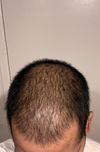
Minoxidil can cause dark, puffy undereyes. Users suggest using caffeine serum, retinol moisturizer, and Remescar eye bags cream to counteract this effect.
Applying hair loss treatments like minoxidil and finasteride, with concerns about side effects and application timing. Some users experience side effects, while others manage without issues, and there's interest in future treatments like pyrilutamide.
The user experienced significant hair loss after extended fasting, initially thought to be Telogen Effluvium, but later suspected male pattern baldness. They tried finasteride briefly but stopped due to concerns about side effects, and are unsure if the hair loss is due to Telogen Effluvium or another cause.
The conversation is about a user trying topical melatonin mixed with minoxidil to reduce hair shedding after not seeing desired results with finasteride and minoxidil alone. Another user suggests that instead of daily updates, the original poster should share their results after a few weeks.
The conversation discusses using a multimodal approach to treat androgenic alopecia, including substances like gamma-linolenic acid, DHA, sulforaphane, melatonin, cetirizine, astaxanthin, fisetin, apigenin, curcumin, limonene, genistein, and berberine. Users also mention using ketoconazole, minoxidil, and low-level laser therapy (LLLT) as part of their hair loss treatment regimens.
Corticosterone inhibits GAS6, affecting hair follicle stem-cell activity, with potential implications for stress-related hair loss. Ashwagandha and Vitamin K are suggested for reducing cortisol, but their effectiveness is debated.
Hair loss discussion includes LLLT treatments and a satirical condition called PLLLTS, causing patients to resemble lighthouses and attract moths. Some users express concern about others taking the satire seriously.
The conversation is about managing allopregnanolone deficiency caused by 5-alpha-reductase inhibitors like finasteride or dutasteride. Specific treatments discussed for hair loss include Minoxidil, finasteride, and RU58841.
A 30-year-old male experienced rapid hair shedding over 6-7 months due to stress, depression, and nicotine/alcohol use, but has since stopped these habits. He seeks advice on remedies, medications, or diet changes to address hair loss.
The conversation discusses diffuse unpatterned alopecia (DUPA) and its possible causes, including sensitivity to DHT, not being androgenic alopecia, being diffuse alopecia areata, or hormonal issues. Treatments mentioned include topical melatonin, Clobetasol Propionate for alopecia areata, and the lack of results from using finasteride, dutasteride, and minoxidil.
The conversation discusses how different factors can stimulate type 1 and type 2 isoforms of 5-alpha reductase, which are enzymes linked to hair loss. Specific treatments mentioned include oral Dutasteride and topical Finasteride.
A user shared their successful hair loss and gray hair reversal routine, which includes Minoxidil, Cetirizine HCl, Latanoprost, Dutasteride, Melatonin, Caffeine, Tretinoin, Vitamin D3, and Vitamin E. They also use a red light cap, oral Minoxidil, and are developing new treatments.
A user accidentally ingested minoxidil instead of melatonin, leading to a humorous discussion about similar mix-ups and the effects of minoxidil. The user now stores the bottles separately to avoid future mistakes.
The conversation discusses alternative and unorthodox hair loss treatments, including RU58841, nandrolone, and dianabol, as well as theoretical approaches involving high doses of estrogen and selective estrogen receptor modulators. These methods are considered extreme and potentially harmful but are explored for those unable to tolerate traditional 5-alpha reductase inhibitors.
The conversation discusses the potential positive effects of melatonin on hair growth. The original poster plans to try both oral and topical melatonin and is seeking recommendations for a good source.
The conversation discusses hair loss concerns, specifically traction alopecia and hair loss from acne. It mentions that sleeping on one side is unlikely to cause traction alopecia.
Elevated bile acids can inhibit the enzyme AKR1C2, leading to increased DHT levels, which may accelerate hair loss in those predisposed to androgenetic alopecia. Treatments mentioned include topical minoxidil and finasteride.
Sugary beverages increase the risk of pattern hair loss in men by 57%, and type 2 diabetes is linked to female pattern hair loss. Reducing sugar intake and using treatments like finasteride and minoxidil may help manage hair loss.
The conversation discusses making a topical melatonin solution for hair loss treatment, questioning if isopropyl alcohol can dissolve melatonin. Melatonin is soluble in lipids and alcohol, but it's unstable and should be mixed fresh regularly; it may help hair growth by affecting certain cellular signaling pathways and has anti-androgenic effects.
Adipose-derived stem cells with ATP improved hair regrowth in male and female mice with androgenetic alopecia. The most effective treatments were low dose stem cells with ATP for males and medium dose stem cells with non-liposomal ATP for females.
People take oral minoxidil at different times, with some experiencing side effects like sleep disturbances or water retention. Many combine it with other treatments like finasteride or dutasteride, reporting varying levels of hair regrowth and side effects.
The conversation is about creating a homemade solution for hair loss treatment, specifically asking for advice on what base to use for topical melatonin. No specific treatments were discussed.
A user is considering switching from regular 5% minoxidil foam to a compounded 5% minoxidil spray with added caffeine, melatonin, and tretinoin for easier application and potentially better results. Another user mentions that tretinoin can enhance minoxidil's effectiveness by converting it to its active form.
The conversation discusses the user's observation of their hair appearing less bald after showering compared to when they wake up. They use a biotin and keratin conditioner and ketoconazole twice a week, while others suggest the difference in appearance could be due to oil build-up or the hair's response to water.
A 22-year-old male experienced hair loss potentially linked to escitalopram, which stopped after switching to vortioxetine. His depressive symptoms improved with continued treatment.
The user is seeking alternatives to Minoxidil due to heart issues and is considering microneedling with topical melatonin, copper peptides, resveratrol+fisetin, or stemoxydine, which reportedly have minimal side effects. They are asking for information on the effectiveness of these treatments.