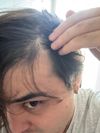
A 20-year-old is experiencing hair thinning due to vitamin D deficiency and has completed a vitamin D prescription without seeing improvement. Suggestions include waiting a few months for potential regrowth or considering treatments like minoxidil or finasteride for androgenetic alopecia.
A 16-year-old experiencing hair thinning noticed a shift from shedding long hairs to shorter hairs, while using Vitamin D, biotin supplements, ketoconazole shampoo, and improving diet. They are questioning if the short hairs indicate regrowth or androgenetic alopecia (AGA).
The conversation discusses hair thinning and the potential role of vitamin D deficiency in hair loss, with suggestions to take vitamin D3 supplements. The user also mentions having diffuse thinning and a slightly receding hairline.
The user experienced side effects from daily 1 mg Finasteride and switched to 0.5 mg every other day, supplemented with creatine, tongkat ali, tribulus terrestris, vitamin D3, bromantane, l-tyrosine, and caffeine. They also use weekly 1.5 mm microneedling and daily 50 mg RU58841, except on microneedling days, to manage hair loss.
The conversation discusses starting topical finasteride for hair loss, with concerns about high dosages. It suggests starting with a lower concentration, like 0.1% or 0.3%, especially with liposomal versions.
PP405 targets hair follicle stem cells differently than exercise-induced lactate, suggesting exercise alone may not replicate its benefits. Minoxidil and finasteride are recommended alongside exercise for hair regrowth, with additional suggestions like spicy food and infrared exposure.
The conversation discusses treatments for androgenetic alopecia, focusing on evidence-based supplements to complement finasteride. Suggestions include oral minoxidil, saw palmetto, pumpkin seed oil, tocotrienols, and various other supplements, while emphasizing the importance of scientific backing and cautioning against saw palmetto if already using finasteride.
The post discusses using Mucuna pruriens, essential oils, and dermarolling for hair loss treatment. The user also mentions pausing testosterone-boosting herbs due to side effects like acne and hair loss.
High cost of studying 3α-Hydroxysteroid dehydrogenase in hair loss led to suggestions of crowdfunding for research. Users discussed using Procyanidin B2/melatonin topical treatment and tracking funds with blockchain.
The user has been using topical finasteride and minoxidil since 2021 and is exploring other hair treatment companies like Xyon and Happy Head due to dissatisfaction with the current product's smell. They question the authenticity of consultations from these companies, suspecting they might be automated.
Alfatradiol is used by some for hair loss, often alongside treatments like finasteride, RU58841, and minoxidil, but its effectiveness is unclear. Some users report no significant improvement, while others note reduced sebum production but experience side effects like gallbladder pain.
Everychem's solution, similar to PP405, has mixed results for hair regrowth, with some users reporting improvements and others seeing no change or worsening hair loss. Users are sharing experiences and updates to determine its effectiveness.
A user is considering a 3-in-1 capsule containing Finasteride, Minoxidil, and Biotin for hair loss. Concerns are raised about Biotin's impact on the effectiveness of Finasteride and Minoxidil, and the cost is unclear without logging in.
Mixing Dutasteride with MCT oil may improve absorption due to its fat-soluble nature. Users suggest taking it with whole milk or using oil-based capsules for better effectiveness.
The conversation discusses the cost and insurance coverage of a comprehensive hormone and DHT blood panel for hair loss, with a focus on finasteride treatment. The user seeks a cheaper alternative to a $700 panel recommended in a video.
Minoxidil, finasteride, and dutasteride are effective for hair loss. Alternative treatments like oils and supplements are less effective and more costly.
Dutasteride and finasteride have similar risks of sexual dysfunction for treating androgenetic alopecia. Users experience varying side effects, indicating individual differences in drug reactions.
Pyrilutamide and RU58841 are androgen receptor antagonists that block receptors without significantly reducing testosterone or DHT levels. Any indirect effect on androgen levels is likely negligible.
Hair loss treatments, specifically about the effectiveness of RU58841 compared to Pyrilutamide. Molecular weights and side effects were discussed in terms of efficacy and cost-effectiveness.
OP experienced diffuse thinning for 11 years and used Minoxidil and Finasteride previously. They now use Pyrilutamide 0.5% and Alfatradiol 0.1%, resulting in significantly reduced hair loss.
GT20029 is discussed as a potential treatment for androgenetic hair loss by targeting androgen receptors, unlike finasteride which reduces DHT broadly. Concerns include its effectiveness, genetic variations in androgen receptors, and availability, with some skepticism about its potential as a true alternative.
A 21-year-old is experiencing hair thinning and is using oral finasteride and topical minoxidil, considering adding oral minoxidil. They are unsure if the condition is androgenetic alopecia (AGA) or telogen effluvium (TE) and are advised to continue treatments and get a blood test.
B-complex vitamins may improve hair appearance but have limited impact on hair loss. Some users also use minoxidil and finasteride for hair loss treatment.
The conversation is about gratitude for a channel that provides support and advice on hair loss treatments, including micro-dosing finasteride, using a derma pen, ketoconazole shampoo, and a topical oil. Some users express appreciation for the community, while others reflect on their experiences and the information shared.
An 18-year-old male with hair loss is considering starting finasteride but is concerned about potential side effects like gynecomastia due to his prolactin levels. He seeks guidance on whether his bloodwork indicates it's safe to begin treatment.
A poem humorously suggests hope for a new hair loss treatment, PP405, while users debate the effectiveness and side effects of current treatments like Finasteride. Concerns are raised about Finasteride's side effects, especially for young users, and skepticism about new treatments is expressed.
The conversation discusses hair loss treatment using finasteride, with the user noting improvements in hair density but a recent decrease in vertex density. Suggestions include adding minoxidil, but the user avoids it due to its toxicity to cats and considers oral minoxidil instead.