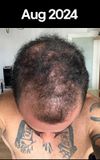
Poor diet and lifestyle contribute to male pattern baldness. Treatments like Minoxidil, dietary changes, and lifestyle adjustments may help slow hair loss.
KX-826 initially improves hair growth but declines after 24 weeks, with mild itching as a side effect. Combining it with minoxidil and finasteride may improve results, but long-term effectiveness is uncertain.
User used topical minoxidil 5% with 0.1% finasteride twice daily, oral minoxidil 2.5mg, and finasteride 1mg daily, along with a hair multivitamin and weekly derma rolling. They missed the medication 3-4 times but still saw significant progress.
A user is considering using RU58841 for female pattern baldness and is also planning to use Minoxidil. They are hesitant to ask their doctor for spironolactone due to its cosmetic nature and are experiencing significant hair loss possibly due to stress and hormonal issues.
User shared 12-month hair loss progress using oral minoxidil, oral dutasteride, and 2% ketoconazole shampoo. They detailed their medication regimen and dosages.
User has seen no improvement after 4 years of using minoxidil and finasteride, and recently started dutasteride. Suggestions include adding oral minoxidil, microneedling, and considering a hair transplant.
The user is seeking advice on treating male pattern baldness (MPB) while dealing with seborrheic dermatitis, specifically asking about the use of finasteride (Fin) and minoxidil (Min). They are concerned about side effects and are looking for recommendations to improve overall hair thickness, especially on the crown.
A user shared their hair progress after three steroid cycles, using 5% minoxidil and 100mg RU58841 daily. They are considering a hair transplant due to paranoia about shedding.
A user asked if it's safe to swallow semen from a partner using topical finasteride and minoxidil. Responses varied, but most suggested it's likely safe, with minimal risk from small amounts of finasteride in semen.
Switching from finasteride to dutasteride involves gradually increasing dutasteride while decreasing finasteride. Studies show dutasteride 0.5 mg daily can improve hair density in men unresponsive to finasteride.
Creatine may increase scalp DHT without affecting serum DHT, potentially speeding up male pattern baldness (MPB) for those genetically prone. Treatments mentioned include Minoxidil, finasteride, and RU58841.
A 25-year-old man discusses his struggles with his mother's opposition to his use of Finasteride for hair loss treatment, despite it improving his condition and self-control after a hair transplant. He expresses frustration over her blaming the medication for various issues and the stress caused by her insistence to stop taking it.
After 11 years on Finasteride, a user's hair is thinning again, suggesting hair may become more sensitive to DHT with age. They plan to introduce Dutasteride once a week, as they cannot tolerate Minoxidil.
A user is experiencing ongoing hair loss despite using 0.5mg dutasteride and 2.5mg oral minoxidil for several years and is seeking advice. Suggestions include ensuring correct diagnosis, checking for other health issues, considering finasteride, trying topical antiandrogens, and consulting a dermatologist.
GT20029, a new hair loss treatment, shows promising results but only a slight improvement over placebo. People are cautiously optimistic, discussing its potential and combining it with existing treatments like Minoxidil and Finasteride.
The conversation discusses the use of topical minoxidil and finasteride for hair loss, with some users combining them with oral treatments. Users share their experiences and opinions on effectiveness, cost, and convenience, with mixed views on whether topical or oral applications are superior.
A user shared their successful hair regrowth using a combination of derma stamping, Retinol, Minoxidil, Dutasteride, and RU58841, with no side effects. Others discussed their varied experiences with these treatments, including concerns about potential side effects like heart issues and sexual dysfunction.
A user shared their 11-year experience with spironolactone and nearly 5 years with finasteride for hair loss, recently adding oral minoxidil and stopping birth control. Various treatments were discussed, including organic options, checking for underlying health issues, considering dutasteride, and the potential role of progesterone in hair loss.
The conversation discusses various treatments for hair loss, including finasteride, minoxidil, dutasteride, microneedling, and checking for nutrient deficiencies. Some users suggest adding hydrocortisone butyrate, low-dose progesterone, or tretinoin to treatment regimens, while others recommend cosmetic solutions like Toppik hair fibers or shaving the head.
TDM-105795 showed promising hair growth results, with higher efficacy than placebo and minimal side effects. It activates dormant hair follicle stem cells and may maintain gains without immediate loss, unlike minoxidil.
The user shared progress photos showing hair regrowth after using Minoxidil, Finasteride, and Nizoral since mid-2023, and plans to replace derma rolling with Tretinoin. They discussed their routine, the initial shedding phase, and their experience with side effects, while others commented on the visible improvement.
A 23-year-old started using 1mg Finasteride and Minoxidil twice daily on September 14 and saw positive results without side effects, boosting confidence and gym performance. They asked if switching from generic Finasteride to Propecia-brand would cause any changes.
Finasteride can reduce DHT levels by about 60%, but its effectiveness varies, and some users experience side effects like cognitive issues. Combining finasteride with other treatments like dutasteride or minoxidil may enhance hair regrowth, but individual responses differ.
The user is hesitant to use finasteride due to potential hormonal side effects and is waiting for the release of pyrilutamide, a new hair loss treatment. Other users suggest trying finasteride, warning about potential regret if hair loss progresses in the meantime.
Dihydrotestosterone (DHT) impacts various skin conditions, including Androgenetic alopecia and seborrheic dermatitis, by causing overactivity in sebaceous glands. Topical medications Tacrolimus and Clobetasol can reduce these inflammatory conditions, and treatments like RU58841, Minoxidil, and Finasteride may also be beneficial.
The conversation discusses HMI-115, a potential cure for hair loss. Users share mixed opinions, with some expressing skepticism and others sharing anecdotal evidence of its effectiveness, including photos of significant hair regrowth from a trial participant.
People shared mixed experiences with RU58841 for hair loss; one person saw no improvement, another had significant gains and uses it with finasteride, while a third had an allergic reaction to the premixed solution. Some mix RU58841 powder into minoxidil themselves.
Quitting minoxidil can lead to significant hair loss, even in areas that were not thinning before, as hair becomes reliant on the treatment. Some users also report losing hair gains when stopping minoxidil despite taking finasteride.
User reported initial hair regrowth with 0.25 mg finasteride taken four times a week, experiencing a second shedding phase, and no side effects. They also mentioned using RU58841 without success and plan to stop after a year.
User has been on finasteride and switched to Dutasteride 6 months ago, using minoxidil, tretinoin, microneedling, and RU-58841, but still experiencing hair loss. Advice given includes waiting 6-18 months for Dutasteride results and checking if it's definitely MPB.