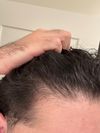
Minoxidil alone may not stop hairloss. Finasteride is recommended for androgenic alopecia, as minoxidil doesn't prevent DHT from miniaturizing hair follicles.
A 29-year-old male experienced significant hair density loss in 18 days despite using Finasteride and Minoxidil consistently for years. He suspects the change in brands or other factors like shedding or androgenetic alopecia might be responsible and is seeking advice.
The user noticed increased hairloss over the past three years and is seeking advice. A suggestion was made to consult a dermatologist or trichologist and consider blood tests, particularly for vitamin D levels, to address potential androgenetic alopecia (AGA).
Clascoterone (Breezula) showed positive results for treating hairloss without affecting cortisol levels. Opinions vary, with some users optimistic about its potential and others critical of its effectiveness compared to existing treatments like finasteride.
The conversation discusses using topical cetirizine as a treatment for androgenetic alopecia (hairloss). Specific treatments mentioned include Minoxidil, finasteride, and RU58841.
Minoxidil increases hair count despite high prolactin being linked to hairloss. Blocking DHT is effective, but not always necessary; HMI-115 is a promising treatment for androgenetic alopecia.
Stress can lead to hairloss by affecting hair-follicle stem cells, and this loss is harder to recover from if one has male pattern baldness (MPB). Treatments like finasteride and minoxidil are used to address hairloss, but stress-related hairloss differs from androgenic alopecia.
Finasteride and minoxidil are recommended as first-line treatments for hairloss, with dutasteride and oral minoxidil as stronger options if needed. Hair transplants should only be considered after achieving stability with medication, and non-surgical options are suggested if medications are ineffective.
SCUBE3 and GT20029 are potential treatments for hairloss, with SCUBE3 stimulating hair growth and GT20029 protecting against DHT. A combined approach using SCUBE3, finasteride or dutasteride, and later GT20029 could provide a comprehensive treatment for androgenetic alopecia.
The conversation discusses a claim that avoiding coffee can lead to significant hair regrowth in individuals with androgenetic alopecia. Participants are skeptical, with some sharing personal anecdotes that contradict the claim, and others discussing the potential role of caffeine in hairloss and the effectiveness of other treatments like finasteride and minoxidil.
Breezula® (Clascoterone) showed promising results in a Phase 2 trial for treating hairloss, being as effective as Propecia with no serious side effects. It might be released between 2021-2022, and a related acne treatment with the same active ingredient could be used in the meantime.
A female user's diagnosis of androgenetic alopecia, and the advice shared in response which suggests taking spironolactone and minoxidil together to prevent hairloss.
IGFBP‐rP1 shows potential for treating androgenic alopecia by influencing hair cycle transitions. Increasing IGF-1 levels may have similar effects to Minoxidil and 5-AR inhibitors in reducing hairloss.
Inflammation plays a significant role in hair follicle miniaturization and androgenetic alopecia, with treatments like ketoconazole shampoo, minoxidil, and finasteride being used to address it. Users discuss the benefits of anti-inflammatory treatments and peptides like KPV, alongside traditional hairloss treatments, to improve scalp health and hair quality.
The conversation discusses how Tretinoin may improve the effectiveness of Minoxidil for treating hairloss by increasing the activity of certain enzymes in hair follicles. One user comments that this information is not new.
A woman experienced significant hair regrowth after six months of using dutasteride and minoxidil, despite initial hairloss due to androgenetic alopecia. She reported minimal side effects and highlighted the effectiveness of these treatments for women, despite doctors' hesitancy to prescribe them.
Kintor Pharma announced successful Phase II trial results for KX-826 in treating hairloss, showing it's comparable to finasteride and can be used with it. Some participants saw a 10 hair/cm^2 increase, which is considered a good outcome at the low dose used.
A 26 year old female diagnosed with androgenetic alopecia who is interested in treatments such as spironolactone, finasteride and Minoxidil to help her hairloss but is worried about side effects like muscle gain, sex drive and effectiveness.
Minoxidil, finasteride, and RU58841 are suggested for hairloss treatment. Supplements like biotin and saw palmetto may help but are not effective for androgenic alopecia.
Consult a doctor before starting treatments like minoxidil and finasteride, as underlying issues like vitamin D deficiency can affect hairloss. While some believe androgenic alopecia is the most common cause, addressing all potential causes can lead to better results.
The conversation discusses the potential use of thermal paper receipts, which contain estrogen, as a treatment for hairloss. Participants humorously debate its effectiveness compared to established treatments like Minoxidil and finasteride.
The conversation discusses using 1% cetirizine, an antihistamine, as a potential treatment for androgenetic alopecia (hairloss). One user plans to try cetirizine instead of finasteride, while others are curious or skeptical about its effectiveness, discussing the role of inflammation in hairloss.
Spironolactone can remain effective for a long time in treating androgenetic alopecia, but it may not completely stop hairloss. Hairloss treatments like spironolactone, finasteride, and dutasteride slow down hairloss rather than cure it, and their effectiveness can vary based on individual response and the aggressiveness of the condition.
Kintor Pharma completed enrolling subjects for a Phase III trial of KX-826 for male hairloss treatment. The trial includes a 24-week treatment period and a 4-week safety follow-up, with results expected in about 6-7 months.
Certain oils and treatments used for natural breast enhancement, like fenugreek oil and shatavari, may also help with androgenetic alopecia due to their estrogen link. The discussion suggests these items might pause hairloss.
Nearly 40% of adults with alopecia areata achieved at least 80% scalp hair coverage after 52 weeks of taking OLUMIANT® 4-mg. The conversation distinguishes this success from androgenetic alopecia, which is a different type of hairloss.
L. reuteri, a probiotic, is being explored for its potential benefits in treating androgenic alopecia, possibly enhancing finasteride's effects and reducing inflammation. The user combines this with finasteride, oral minoxidil, and other supplements, noting some improvement in hairloss.
Kintor Pharma completed patient enrollment for a Phase II trial in China for GT20029, a potential new treatment for hairloss. Some believe GT20029 could replace finasteride if effective, while others discuss finasteride's limited efficacy and potential underreported side effects.
Kintor Pharma has started a Phase II trial in China for GT20029, a potential new treatment for hairloss. Participants are discussing the significance, potential release dates, and comparing it to other treatments and technologies like stem cell hair transplants and SAMIRNA.