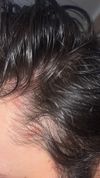
A user is considering exosome therapy from Springs Rejuvenation for hair loss after unsuccessful attempts with PRP, adipose injections, and a laser cap. They are intrigued by the therapy's potential and the clinic's guarantee of 30% improved coverage, despite concerns about FDA approval and high-pressure sales tactics.
The user shared their hair transplant progress, using saw palmetto, vitamins, biotin, zinc, ginseng, ozonized olive oil, and a dermaroller with serum. They avoid finasteride due to trying for a second child.
The conversation is about using a cream to increase minoxidil absorption for hair loss treatment. The user is considering using tretinoin cream on the scalp but is unsure about its safety.
MaximusDurkimus shares experience with 0.25mg Finasteride, Minoxidil-induced lupus, and less than 10mg RU58841 for hair loss. Plans to try 0.025% topical Finasteride with 5% Stemoxydine and possibly Tretinoin, Fluridil, or CB-03-01 in the future.
A new product, Minoxidil booster, which enhances sulfotransferase enzyme activity in the scalp, is now available. The user has started using this product, applied before Minoxidil, to improve their hair loss treatment results.
The conversation discusses adding crushed finasteride tablets to topical minoxidil, but it's advised against because the tablets are not water-soluble and meant for oral use. The suggestion is to take finasteride orally instead.
The conversation discusses using topical vitamin C in shampoo or serum for hair growth and thickness. The user mentions using the Nioxin system to maintain thick hair and is curious about the effects of vitamin C on hair growth.
A sugar gel called 2-deoxy-D-ribose (2dDR) shows potential for promoting hair regrowth by increasing blood supply to hair follicles, similar to Minoxidil, but its effectiveness in humans is unproven. It may benefit those who don't tolerate Minoxidil, but it is not a replacement for treatments like Finasteride or RU58841.
The user has been using finasteride for 7 months and is experiencing some regrowth but struggles with an oily scalp despite trying ketoconazole and salicylic acid. They are seeking advice on managing the oily scalp and are reassured by others that regrowth is visible.
User asks about "The Ordinary - Multipeptide serum" for hair loss, containing Redensyl, Procapil, Capaxyl, Baicapil, and Anagain. Reply states it improves hair appearance but doesn't regrow hair.
A user is seeking suggestions for a custom hair lotion mix containing minoxidil, finasteride, caffeine, niacinamide, and biotin. Another user suggests adding tretinoin, topical valproate, and bimatoprost.
Capronium Chloride and Trichoxidil are suggested as better alternatives to Minoxidil for hair growth without heart side effects. The Japanese Dermatological Association recommends topical Minoxidil over Capronium Chloride.
A user claims to see new baby hairs after using peppermint and castor oil for nearly two weeks, but others are skeptical, attributing the appearance of new hair to the way the hair is styled or pulled back.
The conversation is about finding a source for Alfatradiol 0.1% as most available products are 0.025%. A suggestion was made to use four times the dosage of the 0.025% product.
The user is addressing hair loss with finasteride, dutasteride, oral and topical minoxidil, dermarolling, and shampoos. They are considering adding essential oils to improve circulation.
The conversation is about a user's hair loss treatment regimen, which includes Dutasteride, oral Minoxidil, topical Dutasteride, Minoxidil sulfate, antioxidants, and various supplements. The user is also using a derma stamp and has paused Tretinoin due to a TCA peel recovery.
The conversation discusses a topical hair loss treatment containing 0.1% dutasteride, 6% minoxidil, tretinoin, and ketoconazole. The user is asking for opinions on the effectiveness of this solution.
A user is seeking advice on the efficacy and side effects of homemade topical solutions for hair loss, specifically bicalutamide, estradiol, cyproterone acetate, and spironolactone, as they cannot access RU58841 or pyrilutamide.
The conversation discusses methods to further reduce DHT in the scalp for hair loss treatment, with users suggesting various approaches like using dutasteride, minoxidil, tretinoin, and natural supplements like pumpkin seedoil. Some users also mention using topical applications and scalp massages to enhance the effectiveness of these treatments.
The conversation discusses an ideal diet for promoting hair health, emphasizing biotin, collagen, vitamins C and E, zinc, selenium, anti-inflammatory foods, and blood circulation. It also mentions using finasteride, minoxidil, and dermarolling for hair regrowth.
A user reports significantly reduced hair shedding by using a topical mixture containing 10% Minoxidil, 0.1% Melatonin, 5% Azelaic Acid, 5% Rosemary Oil, and 5% Peppermint Oil, and attributes the success mainly to Melatonin. They also use a copper peptide serum (AHK-Cu) for hair growth and Ketoconazole shampoo for scalp cleaning, but have stopped using other treatments like Finasteride and RU58841.
The conversation discusses using aromatase inhibiting supplements like DIM and Grape Seed extract while on finasteride for hair loss treatment. Users share their experiences and opinions on combining these supplements with finasteride.
A user discusses their struggle with female pattern baldness, mentioning that Minoxidil helped initially but their hair health declined after stopping a specific diet. They seek advice on managing oily, brittle hair and mention using an egg yolk and olive oil mixture as a temporary solution.
The user is experiencing a greasy and dandruff-prone scalp from using RU58841 with glycerin and is seeking alternative carriers for seborrheic dermatitis. They are also using dutasteride 0.5mg.
A 34-year-old man is using natural methods like rosemary and peppermint oil, micro-needling, and low-level laser therapy to manage hair thinning, avoiding medications like minoxidil and finasteride. Despite minimal visible progress, he values the non-medicated approach and remains consistent with his routine.
The user is experiencing scalp itching from a PG ethanol base in their hair loss treatment, which includes 0.025% finasteride and 2.5% minoxidil, and is seeking alternatives without PG or ethanol. Suggestions include Zeuss non-PG foam and Ulo, which do not use PG or hydrocortisone.
Considering a hair transplant, using Pyrilutamide, the potential availability of CosmeRNA, and the significance of taking Minoxidil and Finasteride for long-term results.