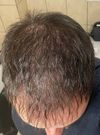
The user left their 2.5 mg pills at home and is considering using 5% topical minoxidil as a substitute. They also inquire about where to obtain over-the-counter minoxidil pills.
A user has been losing hair for two and a half years after a tropical trip and illness. A dermatologist prescribed betamethasone valerate 0.1% lotion, but the user is unsure if it's safe or effective for general hair loss.
The conversation discusses the uncertainty of the legitimacy of minoxidil products in the EU market and mentions baricitinib as an approved, but expensive alternative. A method to test for real minoxidil involves mixing it with bleach to see if it turns orange or brown.
The user applies 2ml of a lotion containing 5% minoxidil, 0.3% finasteride, hydrocortisone butyrate, and cetirizine before bed, but it leaves a residue on the scalp. Another user suggests reducing the amount to 1ml, as 2ml results in a high finasteride dosage.
Tazarotene may be more effective than tretinoin when combined with topical minoxidil for hair loss due to its selective binding to RAR-beta and gamma, though it can cause irritation. Tazarotene's potency can lead to indirect inflammatory reactions despite potentially causing less irritation than tretinoin.
The user is considering switching from a topical minoxidil and finasteride solution to oral minoxidil to improve hair growth, while maintaining oral finasteride. They are concerned about potential shedding and whether they can maintain any new growth.
The user is exploring alternatives to finasteride and dutasteride due to concerns about side effects, and is using rosemary and jojoba oil, ketoconazole, minoxidil, microneedling, multi-peptide serum, saw palmetto, and stinging nettle for hair loss. They are also considering CB 03 01 and spironolactone.
Hair loss treatments discussed include 200mg Spiro, bicalutamide, and finasteride. Endocrinologist advises against bicalutamide and finasteride due to potency and risks.
The conversation is about someone seeking a doctor in the EU who prescribes spironolactone or bicalutamide for female pattern hair loss, as they are having difficulty finding treatment options beyond Minoxidil in Austria. They are asking for recommendations and are open to direct messages for assistance.
The conversation discusses concerns about oral minoxidil potentially aging the face by affecting collagen, questioning its systemic effects. The user has successfully used topical minoxidil for years and is hesitant to switch to oral minoxidil.
The conversation discusses the potential benefits of castor oil for hair thickening, with one user noting it may increase prostaglandin E2 and decrease PGD2. The original poster plans to take 1-2ml orally daily.
The conversation is about the claim that oral minoxidil can make hair grow on bones. The conclusion is that this claim is not true, as evidenced by the user's head being bald while the body is furry.
Topical finasteride in a liposomal formulation reduces systemic absorption compared to ethanol solutions. The user is seeking sources for such products, noting that popular options like morr-f are not liposomal.
A user is asking if Minoboost F, a topical solution with 5% Minoxidil and 0.1% Finasteride, is effective or a scam due to the lack of online reviews. They seek opinions and reviews from others.
Alfatradiol is used as a mild treatment to slow or stabilize hair loss, often alongside finasteride and pumpkin seed oil. Users report reduced shedding and minimal side effects, but minoxidil is noted as more effective for regrowth.
Clascoterone is promising for hair loss, showing 24.5% improvement in satisfaction compared to placebo. Users consider it an alternative to finasteride, with concerns about absorption and side effects.
The conversation is about using distilled water as a solvent for topical finasteride to reduce systemic absorption. The user is considering avoiding ethanol and propylene glycol to achieve this.
Topical sodium valproate may promote hair growth by inhibiting GSK3β, allowing beta-catenin to proliferate, but it has potential side effects and requires more research. The conversation also mentions skepticism about a product called Vdphlo1, which includes sodium valproate and other ingredients.
PP405, a potential hair loss treatment, is facing delays in releasing Phase 2 results, causing frustration among users who compare it to past failed treatments. Despite skepticism, some remain hopeful about PP405's future, while others discuss alternative treatments like Clascoterone and its expected market release.
The user shared their 6-month progress using 0.25 mg finasteride, topical minoxidil, and dermastamping, noting good results but experiencing increased sleepiness. Another user suggested minoxidil might be causing the sleepiness, and the original poster considered adjusting their treatment.
A user reported thickening their hairline using a nightly mixture of castor oil, peppermint oil, rosemary oil, and sandalore, without using minoxidil due to side effects. They also continued using alfatriodol for DHT blocking and saw modest improvements after 6 months.
The conversation discusses the effectiveness of peppermint oil and dermarolling for hair regrowth, with one person suggesting that only dermarolling is effective and comparing peppermint oil's effectiveness to that of an egg.
The conversation is about the anticipated results of Pelage's Phase 2a clinical trial for their topical hair loss treatment, PP405. Users speculate on when the results will be available, noting that delays might indicate less successful outcomes.
Bicalutamide is discussed as a treatment for hair loss, particularly in females, with some users cautioning against its use due to potential side effects. The conversation also mentions using finasteride and other anti-androgens, with some users recommending more traditional treatments like dutasteride.
The user stopped using finasteride and RU58841 and is considering CB-03-01 for androgenic alopecia but is concerned about the cost and effectiveness, especially at a lower dose than in clinical trials. They are also using minoxidil, micro-needling, and nizoral shampoo but are unsure about the correct application method for CB-03-01.
A user is using a mix of 15ml coconut oil and 6 drops of rosemary oil applied to the scalp three times a week for an hour before washing, seeking natural hair growth methods before considering medications. The user asks if this technique is effective and requests respectful advice.
The conversation discusses hair loss treatments, mentioning minoxidil, finasteride, RU58841, VDPHL, GT20029, and follicle cloning as potential solutions. It also reveals that the discussion about PP405 was an April Fool's joke.