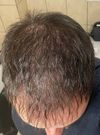
A user experienced high estrogen levels after 10 months of taking 1mg oral finasteride but is happy with hair regrowth. They are considering switching to topical finasteride and are also taking DIM and Zinc supplements.
A man in his 40s treating his slow balding with a daily regimen of 2.5% spironolactone topical solution and Piroctone Olamine Shampoo. Despite initial hair shedding, he experienced no side effects and plans to continue the treatment for at least a year.
Clascoterone is considered overhyped and not as effective as finasteride or dutasteride, but it may be useful as a supportive treatment in combination with other therapies. Users express skepticism about its effectiveness compared to clinical trials, with some suggesting it could be beneficial for those who cannot tolerate other treatments.
The user is using RU58841, finasteride, dutasteride, and minoxidil to slow down aggressive hair loss but is still experiencing hair shedding due to high testosterone levels. They plan to use ostarine to lower testosterone and prevent hair loss while maintaining muscle mass, and will continue using the other treatments.
Doctors are testing verteporfin topically for healing and potential regeneration after transplants. The user is asking how it is formulated for topical use, such as if it's mixed with a carrier gel.
Clascoterone phase 3 results show promising improvements in hair count, but concerns about high costs and lack of detailed data remain. Users compare it to existing treatments like Minoxidil and Finasteride, expressing skepticism about its accessibility and effectiveness.
Peptides like TB500, KPV, GHK-CU, and BPC-157 are overhyped for hair growth with limited proven effectiveness in humans. Combining peptides with delivery methods like iontophoresis and sonophoresis shows promise, but many claims remain unproven.
Biotin is being misleadingly marketed as a primary treatment for androgenic alopecia, overshadowing more effective treatments like finasteride and minoxidil. There is a call for increased awareness and accountability to prevent misinformation.
The conversation is about the best vehicle for RU58841, comparing trichosol and Garnier/Vichy Stemoxydine, avoiding propylene glycol (PG) or ethanol due to previous scalp damage. The user is also seeking sources for these products in the EU.
Switching from minoxidil foam to topical solution and considering adding caffeine, melatonin, or cetirizine. Currently using 2.5mg oral minoxidil and 1mg oral finasteride, planning to ask for 0.5mg oral dutasteride and 5mg oral minoxidil.
The conversation discusses aggressive hair loss treatments, including finasteride, dutasteride, minoxidil, topical cetirizine, and experimental options like Estrogel, oh-flutamide, and RU58841. Users share experiences and suggest trying oral minoxidil and el cranell, noting the complexity and challenges of treating hair loss.
The user is trying RU58841, oral minoxidil, and dermarolling to combat hair loss caused by increased scalp testosterone after using finasteride and dutasteride. They plan to document their results.
Pelage is delaying the start of phase 3 trials for PP405 to 2026 due to necessary regulatory processes, despite having $120 million in funding. Users discuss the potential of PP405 for hair regrowth, with some expressing skepticism and others hopeful for new treatments like Breezula.
The conversation is about individuals considering waiting for Breezula to treat hair loss instead of using Finasteride due to concerns about side effects. Some are opting for Finasteride now, while others are wary of its impact on neurosteroids.
Koshine KX-826 has different versions, and the green version uses a plant-based carrier that may be less irritating for those sensitive to propylene glycol. Users report irritation with some versions of KX-826.
PP405 is progressing to Phase 2b trials, with results expected in late 2025 or early 2026, and potential Phase 3 trials in 2026. Some users experienced side effects from finasteride and are hopeful for PP405 as an alternative treatment.
Ethosomes are suggested as an effective delivery method for topical finasteride solutions, requiring the addition of a phospholipid like soya lecithins. The user questions why do-it-yourself solutions don't commonly use ethosomes despite their potential benefits.
The conversation discusses affordable options for topical Finasteride, including products like Morr F, 82F, and Essengen 6 Plus, with concerns about availability and cost. The user is seeking effective and convenient solutions, considering options like compounding pharmacies and homemade solutions.
A natural compound called C3A from Aronia Chokeberry can help prevent hair loss by counteracting the effects of DHT. The user has been taking 50 grams of dried organic Aronia Chokeberry daily for 30 days and will update with photos in 60 days.
The user is using Dutasteride and oral Minoxidil for hair regrowth and is considering adding topical Minoxidil but is allergic to propylene glycol, which is present in the product they found. They need a solution with tretinoin that does not contain propylene glycol.
Spraying pyrilutamide on the crown area shows noticeable improvement compared to using a dropper. Applying directly to the vertex is challenging without wasting the product.
The conversation is about making homemade topical finasteride, discussing mixing it with Kirkland minoxidil and creating a solvent with alcohol, glycerin, and water. A formula suggestion includes 50% ethyl alcohol, 25% propylene glycol, and 25% distilled water.
A user is considering a $5,295 one-year hair loss program from HairClub/Bosley, which includes treatments like finasteride, minoxidil, and a DNA test to personalize treatment. Opinions are mixed, with some suggesting cheaper alternatives like standard medications and questioning the value of the program.
The user is exploring alternatives to finasteride and dutasteride due to concerns about side effects, and is using rosemary and jojoba oil, ketoconazole, minoxidil, microneedling, multi-peptide serum, saw palmetto, and stinging nettle for hair loss. They are also considering CB 03 01 and spironolactone.
There is an inconsistency between the molecular weight and formula listed on EveryChem's product page and the analytical PDFs for 3HP and PP30, suggesting a possible error in the product description. Concerns are raised about EveryChem's business practices and lack of transparency in testing and manufacturing.
The user is looking for a PG-free solvent in the UK or EU to make their own pyrilutamide solution for hair loss and is currently using finasteride, considering minoxidil. They hope pyrilutamide will help stabilize their hair loss.
Minoxidil sulfate is considered for those unresponsive to regular minoxidil, with some trying a 10% formulation from Folligenz. Concerns exist about the product's stability and transparency, but some users report positive initial results.
The conversation is about using Latanoprost 0.01% solution for hair loss and seeking success stories. It mentions that Latanoprost works differently from Minoxidil, Finasteride, and RU58841.