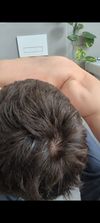
Stopping finasteride and dutasteride due to military service in Egypt. Temporary hair shedding may occur, but hair should recover after resuming treatment.
Switching from topical to oral minoxidil caused heavy shedding and thinner, brighter hair. The user is seeking advice on whether hair can recover to its previous state.
The user switched to oral Dutasteride, added RU58841, and used Ketoconazole-enriched Minoxidil but still experiences scalp itch and hair loss after 4 months. They are advised to give Dutasteride more time, consider seeing a dermatologist, and explore other topical solutions.
Creatine may increase DHT levels, but its impact on hair loss is unclear and not well-studied. Many users report no significant hair loss while using creatine alongside finasteride, though some experience increased shedding.
The conversation is about a user preparing to join the ABS-201 clinical trial for hair loss treatment, which involves a prolactin inhibitor. The user plans to update others on their progress if enrolled.
Pelage executives' hairlines were discussed, with speculation about them using PP405 for hair regrowth. Concerns were raised about using untested drugs, with some suggesting executives might not risk using them without safety data.
The user is experiencing significant hair shedding after starting RU58841, despite using dutasteride and oral minoxidil for over a year without stabilization. Others suggest continuing the treatment as shedding can be a normal phase, but caution that RU58841 is unpredictable.
Switching from topical to oral minoxidil and dutasteride led to severe hair thinning and shedding, with no side effects. The user is unsure if this is a temporary shedding phase or if oral minoxidil is less effective.
A user switched from 2% to 5% minoxidil, alongside using finasteride and dermarolling, to address hair thinning and is curious about potential shedding. They have not experienced noticeable hair loss or shedding since starting the treatment.
RU58841 worsened hair condition, causing thinning and unusual patterns. The user stopped using it two months ago but hasn't seen recovery, and there's speculation about androgen receptor upregulation.
Pelage Pharmaceuticals raised $120M for their hair loss treatment, PP405, showing strong investor confidence despite limited data. There is skepticism about its efficacy and long-term effects compared to treatments like GT20029.
The individual is using oral minoxidil and finasteride to treat androgenetic alopecia with good results but is considering stopping due to concerns about long-term effects on the heart and potential hair dependency on the medication. They are also contemplating the impact of hair loss on gender dysphoria and considering the use of wigs as an alternative.
The user has been using Finasteride for hair loss and is considering adding alphatradiol, stemoxydine, or 2% minoxidil to their regimen. They are concerned that stemoxydine, which shortens the resting phase of hair, might accelerate hair loss in those not using Finasteride by depleting hair cycles without strengthening miniaturized hairs.
The conversation discusses the pros and cons of dutasteride for male pattern baldness, with a focus on its long half-life. The user, a physician, also mentions that switching from finasteride to dutasteride can cause temporary hair loss until dutasteride reaches effective levels or accelerates the hair cycle.
A user shared that after quitting caffeine and restarting oral minoxidil, they experienced significant hair regrowth, suggesting that caffeine might interfere with minoxidil's effectiveness by blocking adenosine receptors. They also mentioned side effects like water retention and dizziness, which subsided after a few weeks, and are not using any DHT blockers.
The conversation discusses the potential for developing a biologic "DHT sponge" to neutralize DHT in the bloodstream as a treatment for hair loss, suggesting it could be more targeted and have fewer side effects than current treatments like finasteride and dutasteride. Concerns include the complexity, cost, and potential side effects of such a treatment, as well as skepticism about its feasibility and market interest.
The user is considering switching from finasteride to dutasteride for hair loss treatment and is unsure when to stop finasteride. Dutasteride takes about 15 days to reach significant DHT suppression compared to finasteride.
The user has been using topical minoxidil and dutasteride but is experiencing significant hair shedding, including smaller hairs. They are concerned if this shedding indicates the treatment is working.
User started using Pantostin Alfatradiol after watching haircafe on YouTube and noticed thicker hair. They wonder why it's not more popular, as it's a 5α-reductase inhibitor with a different mechanism than minoxidil.
A 3 year journey of hair loss, with recession and diffuse thinning; the user has been taking finasteride for 3 years and is now switching to dutasteride and oral minoxidil, and may start using topical minoxidil soon.
The user is using Dutasteride, Minoxidil, microneedling, RU58841, and tretinoin for hair loss. They are experiencing shedding but notice new hair growth and are curious about the timing of future shedding phases.
A 35-year-old transgender woman experienced hair regrowth with feminizing HRT, adding dutasteride and bicalutamide, and plans a hair transplant for further improvement. Estrogen also improved skin appearance, and the user advises against cisgender men using feminizing HRT for hair regrowth.
Switching from finasteride to a dutasteride/minoxidil pill resulted in worse hair loss for the user. They are seeking advice on the effectiveness of the product from Happy Heads.
KX-826 (Pyrilutamide) 0.5% and 1.0% solutions showed promising results in increasing hair count for male androgenetic alopecia, with the 0.5% dose slightly outperforming the 1% dose. The treatment was well-tolerated with no sexual side effects, but skepticism remains due to past inconsistencies in trial results.
PP405 shows promise in regenerating hair by activating dormant follicles. Other treatments like VDPHL01 and Breezula are also advancing, providing new hope for hair loss solutions.
The conversation humorously discusses inducing goosebumps to potentially reverse hair loss, with mentions of using cold therapy and muscle exercises. It also references other unconventional ideas like removing a testicle to lower DHT.
GHK-Cu and AHK-Cu peptides show limited success for hair loss, with skepticism about their effectiveness and concerns about misleading claims. Users report better results when combined with treatments like finasteride, dutasteride, minoxidil, and other methods.