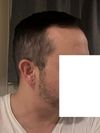
The user is pleased with their hair transplant results after six months and seeks feedback. The conversation is positive, with others affirming the success of the procedure.
The conversation discusses the high cost of CB-03-01, a topical antiandrogen for hair loss, which is considered safe and remains localized upon application. It questions whether the expense is justified compared to the lower risks it poses relative to finasteride.
A user shared their 4-month hair transplant progress with 3740 grafts, showing before and after pictures. They had a generally good experience, except for the anesthesia part.
A user from China is participating in a clinical trial for Pyrilutamid, a potential hair loss treatment originally developed for prostate cancer. They've experienced no side effects except initial scalp itchiness, and will share results after the year-long trial.
Hair cloning was predicted to be a baldness cure within 3-4 years in 2004, but it has not materialized. Users express frustration and skepticism about the delay.
The conversation discusses the safety and trustworthiness of ordering RU58841 from Lyphar Biotech in China, with a focus on pricing and reliability. The user is seeking advice on whether to proceed with the purchase or consider alternative sources.
A potential baldness cure, possibly PP405, might be available before the release of GTA 6, which is delayed to 2026 or 2027. There is skepticism about the effectiveness and release timeline of PP405.
The conversation discusses using 2-deoxy-d-ribose (2DDR) for hair regrowth, with users sharing mixed experiences and side effects like hair loss in new areas and increased anxiety. The original poster plans to continue testing and comparing it to minoxidil, noting potential instability in 2DDR formulations.
The conversation is about comparing keratin hair fibers to Gossypium Herbaceum hair fibers for diffuse hair loss. The user prefers keratin fibers for their durability and is seeking a bulk purchase option.
The conversation discusses androgenetic alopecia (AGA) and questions why treatments focus on lowering DHT levels instead of building resistance to it. It also touches on hair transplantation techniques using body hair.
RU58841 lacks FDA approval due to financial and safety concerns, including potential cardiological side effects. The company abandoned further research, and users report adverse effects like heart palpitations and gynecomastia.
The conversation discusses finding a source for RU58841 in Australia. Users suggest that while RU58841 is effective, it may harm the scalp, and recommend trying koshine's kx as a safer alternative.
KX-826 is a potential hair loss treatment, with users discussing its effectiveness compared to finasteride and concerns about its trial results. Some users express skepticism about new treatments, while others discuss the potential of androgen receptor degraders and the need to manage drug resistance.
User tries dermapen for hair loss and plans to use non-mainstream topicals like c60, ghk-cu, and ptd-dbm with valproic acid. They also use a head massager and modified LLLT belt for additional treatment.
The user humorously describes trying various hair loss treatments, including minoxidil, finasteride, and RU58841, with a satirical twist involving psychedelic experiences and imaginary entities. They mistakenly used LSD instead of RU58841 and plan to continue experimenting with other substances.
Exploring treatment options for male pattern baldness, including minoxidil, finasteride, and RU58841, with a focus on Eucapil, a topical agent. The post also discusses research from various sources about the efficacy of these treatments.
Creatine generally does not affect hair loss, but some report increased shedding due to higher DHT levels. Many manage hair loss with dutasteride, finasteride, and minoxidil.
KX-826 users report increased shedding, with some experiencing more shedding at higher concentrations. Users are discussing where to purchase the product.
The conversation discusses hair loss treatments, mentioning minoxidil, finasteride, RU58841, VDPHL, GT20029, and follicle cloning as potential solutions. It also reveals that the discussion about PP405 was an April Fool's joke.
A double-blind clinical study that found ingestion of tocotrienols resulted in a 34.5% increase in hair regrowth compared to the placebo group, and discussion about potential side effects and cost of supplementation with vitamin E pills. The conversation noted that it may be more effective than commonly used treatments like minoxidil and finasteride.
The conversation discusses Breezula, a hair loss treatment, and its Phase 3 clinical trial recruitment at 50 locations. Specific treatments mentioned include Minoxidil, Finasteride, and RU58841.
Treatment options for female alopecia androgenetica, discussing the availability of spironolactone online in The Netherlands and other potential treatments like finasteride, minoxidil and RU58841.
The conversation discusses using topical synthetic prostaglandins like Bimatoprost, Latanoprost, and cetirizine for hair growth. The user shares a link suggesting these treatments may be effective.
The conversation discusses a hair loss treatment regimen including oral dutasteride, oral minoxidil, tadalafil, and the recent addition of RU58841. The user shares experiences with these treatments, noting significant hair regrowth and stabilization, and discusses the cost and preparation of RU58841.
Clascoterone (CB) shows an excellent safety profile with no serious side effects, but its effectiveness may decline after six months, making it more suitable as an adjunct treatment with finasteride and minoxidil rather than a standalone solution. Some argue it could be better than finasteride due to its protection against testosterone, but its long-term efficacy remains debated.
Pelage is recruiting for phase 2 trials, showing promise for treating bald regions. The discussion highlights its potential effectiveness based on its mechanism of action.