Search
for
Sort by
Community Join
480-510 / 1000+ resultscommunity New warning by FDA on topical finasteride
The FDA warned that topical finasteride can cause serious side effects like sexual dysfunction and brain fog, similar to oral finasteride. Compounded topical formulations pose additional risks due to lack of regulation.
community Clascoterone 12 months phase 3 result out
Clascoterone is promising for hair loss, showing 24.5% improvement in satisfaction compared to placebo. Users consider it an alternative to finasteride, with concerns about absorption and side effects.
community 8 months minoxidil + dermaroller 0.5 mm (M50)
community Masseter Muscles and the Tension Theory of Baldness
The conversation discusses the tension theory of baldness, suggesting that over-developed masseter muscles may harm hair follicles. Botox injections to relax these muscles reportedly led to an 18% increase in hair count in men with AGA.
community My dermatologist gave me Ell cranell?
The user is seeking advice on a hair loss treatment called Ell Cranell, which contains Alfatradiol. Another user shared information from a study stating that Alfatradiol only slows down or stabilizes hair loss, but does not increase hair density or thickness.
community How’s this progress looking? (18yo, 3.5m min, 2m fin)
An 18-year-old is using minoxidil, finasteride, and tretinoin for hair loss, with concerns about uneven temple progress. They have been on minoxidil for 3.5 months and finasteride for 2 months.
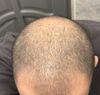
community Question about finasteride
Finasteride may help thicken baby hairs on the crown, potentially reducing visible bald spots. Effectiveness varies for each individual.
community Watching my younger brother bald hurts so much.
A 19-year-old is distressed about his 17-year-old autistic brother's hair loss, projecting his own insecurities despite being on finasteride and dutasteride. Replies suggest the brother might not care about balding, and the poster should address his own issues.
community common ideas amongst bald communities that doesnt help at all in my opinion
Balding is challenging, and relying on medications like finasteride is often seen as a better option than constantly shaving or trying to compensate in other areas. Many feel that societal expectations to "own it" or drastically change oneself to cope with baldness are unrealistic and burdensome.
community 50M Norwood 6. 12 month topical finasteride/minoxidil results
community 6month update post hair transplant
community What blood results (if any) could be affected by Fin/Min?
Finasteride can increase total testosterone and potentially raise estrogen levels, leading to side effects. Biotin in combined tablets can falsely elevate thyroid hormone levels in blood tests.
community Rate Cbum hair transplant after 1 year
The hair transplant has a straight, unnatural-looking hairline that many find unappealing. The person is not using finasteride or minoxidil, which may affect future hair retention.
community Will oral minoxidil work if you're missing the SULT1A1 enzyme?
community Vitamin D3 for hair loss. Thought?
community Whenever I see a woman I'm attracted to I feel immense shame and self hatred
A person feels intense shame and self-hatred due to baldness and poor self-image, affecting their confidence and social interactions. Suggestions include therapy, exercise, braces, hair transplants, and using finasteride.
community Why does MPB only affect the scalp
Male pattern baldness (MPB) may be influenced by androgen receptors in scalp hair follicles and potentially poor blood flow. Transplanted hair is not immune to DHT, and factors like inflammation and scalp tension might also contribute to hair loss.

community It seems that topical Minoxidil can also cause pericardial effusion after all
Topical Minoxidil may cause pericardial effusion. Caution is advised when using Minoxidil, even topically.
community spironolactone vs bicalutamide What is the difference between them for androgenic alopecia for women?
Hair loss discussion involves spironolactone and bicalutamide for women's androgenic alopecia. Focus on effectiveness and side effects.
community are all vellus hairs likely to go terminal if fin/dut + min + tret are used long enough?
The user has been using a combination of finasteride/dutasteride, minoxidil, tretinoin, and hydrocortisone with microneedling and ketoconazole shampoo for hair loss. They are asking if the baby hairs growing will turn into terminal hairs with continued treatment.
community Topical min and dermarolling with seborrheic dermatitis
The user is managing hair loss with oral finasteride, recently switching to dutasteride, and topical minoxidil, but faces challenges due to seborrheic dermatitis. They seek advice on effective regrowth methods that don't worsen their condition, with suggestions including various shampoos like Vichy Dercos and ketoconazole.
community Fluridil/topilutamide experince
A user is trying fluridil/topilutamide for hair loss and experiencing side effects like pain in the testicles and genital discomfort. They previously had adverse effects with finasteride, dutasteride, and RU58841, and are considering other treatments like topical dutasteride and spironolactone for maintenance before a hair transplant.
community 19 yo destroyed hairline even though using Fin/min/microneedling for 16months/11months/3months … Idk what to do.
A 19-year-old has been using finasteride, minoxidil, and microneedling to treat hair loss with no regrowth, feeling mentally affected by it. Advice given includes continuing treatment, considering a hair transplant, addressing potential vitamin deficiencies, and possibly switching to dutasteride or adding ketoconazole shampoo.
community Diffuse thinner- 2 months progress. Oral Fin,Min, topical RU
community Has there been any update or progress on the 3-alpha hydroxysteroid dehydrogenase hypothesis?
community Can't tell if I'm balding, or simply inheriting my father's bizarre hairline - please let me know your thoughts [33M]
A 33-year-old man is concerned about potential hair loss, comparing his hairline to his father's and noticing increased shedding and thinning. He is considering treatments like Minoxidil and Finasteride but is unsure if he has male pattern baldness.
community 1 year on Oral Fin/min. Not feeling super great about it.
community Wrap it up everyone. CB-03-01 is another failed treatment
CB-03-01 is considered a failed treatment for hair loss, with future hopes pinned on PP-405 and GT-20029, expected by 2030. Alternatives like hair transplants and SMP are discussed, while some users express frustration over the slow progress of treatments like Breezula.
community Dutasteride Infertility Debunked: Low T causes true infertility.
Dutasteride and finasteride may temporarily affect semen quality but are unlikely to cause permanent infertility. The Kim et al. study is criticized for poor methodology, and many prefer hair retention over potential fertility concerns, using treatments like dutasteride, finasteride, and minoxidil.