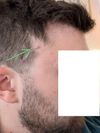
A 27-year-old male with diffuse hair loss, including the donor area, did not respond to finasteride, dutasteride, or minoxidil. He suspects his hair loss may be linked to a mild connective tissue disorder, possibly affecting the structural support of hair follicles, rather than being purely hormonal.
People on finasteride or dutasteride cannot donate blood due to the risk of birth defects if the blood is given to a pregnant woman. It's advised to stop finasteride for a month and dutasteride for six months before donating.
A male in his early 20s with CCCA (scarring alopecia) started treatment with Finasteride, Fluocinolone, and Doxycycline. Steroid injections were suggested but not yet done.
The user is using topical dutasteride, finasteride, minoxidil, and tretinoin but seeing no results or side effects. They also microneedle every two weeks but experience little bleeding, questioning if a thick scalp is preventing treatment effectiveness.
Dr. Bloxham's 9-month update on FUT scar revision with Verteporfin shows promising results. Excitement is high for FUE, which appears highly effective based on Dr. Barghouthi's findings.
Dihydrotestosterone (DHT) impacts various skin conditions, including Androgenetic alopecia and seborrheic dermatitis, by causing overactivity in sebaceous glands. Topical medications Tacrolimus and Clobetasol can reduce these inflammatory conditions, and treatments like RU58841, Minoxidil, and Finasteride may also be beneficial.
Vitamin D deficiency can hinder hair recovery, and addressing it may help with hair loss. Hair loss may result from various issues like excess DHT, vitamin deficiency, or scalp inflammation.
Dr. Muñoz's discovery suggests that targeting potassium channels in fibroblasts could reactivate hair growth, offering new treatment possibilities for alopecia. Potential strategies include using minoxidil, diazoxide, and other potassium channel openers, as well as bioelectric devices and direct growth factor applications.
A 36-year-old man with androgenetic alopecia suspects copper and zinc deficiencies may be accelerating hair loss and is supplementing copper to address this. He is also monitoring blood sugar levels due to previous prediabetes concerns and plans to test for insulin resistance.
The user is experiencing hair thinning and has a vitamin D deficiency, which they suspect might be causing the issue, but they are also considering androgenic alopecia (AGA) as a cause. They are currently using minoxidil and are unable to get finasteride prescribed, while others suggest addressing the vitamin D deficiency and consulting a dermatologist.
User considers adding Alfatradiol to their topical finasteride treatment for hair loss. Others discuss Alfatradiol as a weak estrogen and 5α-reductase inhibitor used for pattern hair loss in men and women.
Clascoterone 5% solution (Breezula) is a promising alternative for androgenetic alopecia, showing continued hair growth with consistent use and no significant side effects. It may be suitable for those who cannot tolerate finasteride or dutasteride, especially when trying to conceive.
The conversation discusses hair loss treatments, including oral finasteride, topical minoxidil, and microneedling, and the potential impact of Vitamin D and folic acid deficiencies on hair regrowth. It suggests that while male pattern baldness is the primary cause, addressing vitamin deficiencies may aid in improving regrowth.
A 15-year-old is experiencing uneven hair loss, with one temple receding significantly. They are considering using finasteride, minoxidil, or dutasteride to slow hair loss before visiting a dermatologist, and may consider a hair transplant in the future.
Topical sodium valproate may promote hair growth by inhibiting GSK3β, allowing beta-catenin to proliferate, but it has potential side effects and requires more research. The conversation also mentions skepticism about a product called Vdphlo1, which includes sodium valproate and other ingredients.
A user experienced androgenic alopecia starting at the vertex without frontal hairline recession and is seeking information on this pattern. Another user noted that vertex or diffuse hair loss is common among men.
The safety of combining alfatradiol and fluridil with finasteride as a potential treatment for male pattern baldness, which is approved in the European Union. Other treatments such as minoxidil and RU58841 were also discussed.
Alfatradiol is considered safe but less effective than finasteride for hair loss. One user reported subtle regrowth using alfatradiol with finasteride and minoxidil, while another found alfatradiol ineffective.
Concerns about the long-term safety of VDPHL01, an extended-release minoxidil, due to potential risks similar to Cantu syndrome, were raised, highlighting the lack of monitoring for chronic connective tissue changes. The conversation suggests that while the treatment may improve hair growth, it could lead to issues not detected in short-term trials.
A 15-year-old experiencing severe diffuse thinning plans to use minoxidil, dermarolling, and possibly ketoconazole, with hopes to later incorporate finasteride. Concerns about starting finasteride too young and the need for a dermatologist consultation are discussed.
The conversation discusses a small patch of missing hair and whether treatments like Minoxidil, finasteride, or RU58841 could help. The user is seeking advice on addressing this specific hair issue.
Avixis Alfatradiol is a topical 5-alpha reductase inhibitor available in Latin America and Germany, but its effectiveness is questioned. A user reported worsened hair loss after using it and recommended finasteride instead due to its proven effectiveness and lower cost.
An arthritis drug, baricitinib, is discussed as a potential treatment for autoimmune alopecia, not androgenetic alopecia. Ritlecitinib is also mentioned as a possible treatment for scarring alopecia.
Hopeful treatments for hair loss, including Verteporfin, Androgen Receptor Degradation, and SCUBE3. These treatments offer potential solutions to slow or stop the effects of androgens on the scalp.
A 22-year-old male experiencing hair thinning and loss, possibly due to seborrheic dermatitis or low vitamin D, is cautious about using minoxidil or finasteride due to heart palpitations and high blood pressure. Suggestions include using ketoconazole shampoo to control inflammation and focusing on treating the dermatitis first.
The conversation is about using PTD-DBM and valproic acid for hair loss. The user is inquiring about the dosage of these treatments, noting that valproic acid is used at a 7.5% solution.
A 30-year-old woman with androgenetic alopecia is considering bicalutamide to slow hair loss but is concerned about its impact on muscle growth due to its anti-androgen effects. Alternatives suggested include dutasteride, spironolactone, RU58841, and minoxidil, with concerns about bicalutamide's side effects.
CB 03 01 (Breezula) was tried for hair loss but showed no significant improvement, with issues in dissolving and application. Finasteride and dutasteride remain the most effective treatments, while minoxidil is also used; CB's effectiveness is questioned, and topical alternatives like bicalutamide are considered.