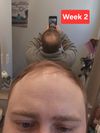
Hair loss treatment progress with Dut, Min, Keto, needling, and RU/Min/Fin/Dut topical. User noticed improvement, believes RU and needling most effective.
ET-02 is seen as promising for addressing hair loss and graying, but PP405 is more advanced in development and has better publicity. Some users plan to use both treatments alongside minoxidil and dutasteride.
ET-02, a new hair loss treatment, shows promising results with a 6-fold increase in hair count, potentially outperforming minoxidil by activating stem cells in hair follicles. Further trials are ongoing to confirm its efficacy and safety, with potential market release in the future.
The conversation humorously discusses various methods of applying minoxidil for hair loss, with some users suggesting oral minoxidil as a more convenient option despite potential side effects. The original poster jokes about using a red light helmet with mesotherapy needles for continuous minoxidil application.
The conversation discusses using TH16, a topical melatonin with resveratrol, and stemoxydine for hair maintenance, avoiding finasteride and minoxidil due to side effects. The user is considering a low-dose topical finasteride despite sensitivity.
A 26-year-old is using 5% minoxidil twice daily and 1 mg finasteride every other day, along with biotin and collagen supplements, for hair regrowth. They apply minoxidil to the temples and crown and experienced initial shedding in the first month.
People with diffuse thinning and retrograde hair loss are discussing treatments like finasteride, minoxidil, and dutasteride, with some reporting improvements and others experiencing issues like scalp inflammation and increased sebum. Suggestions include addressing scalp inflammation, considering gut health, and possibly using topical antiandrogens or micro-needling.
A joke about someone named "Fin Diesel" living life one milligram at a time, referencing the treatments Finasteride and Minoxidil used to treat hair loss; users discussed whether the look would be better with or without hair.
The user transitioned from finasteride to Cyproterone and started using Minoxidil, resulting in healthier hair and regrowth. They plan to wean off Minoxidil in a year, depending on regrowth.
A 30-year-old is using topical minoxidil 6% and finasteride for hair loss, showing significant progress over five months. They also use dermastamping, nizoral shampoo, and had a hair and scalp treatment.
The user experienced red pimples and a rash from using topical minoxidil, possibly due to propylene glycol. Suggestions included seeing a dermatologist, switching to foam without propylene glycol, using Nizoral, and adjusting application timing.
The user experienced hair regrowth over four months using 5% topical minoxidil, oral biotin, and saw palmetto. They also use rosemary and mint conditioner and biotin shampoo.
A user's successful 6-month journey with Minoxidil, Finasteride and 0.05 Derma Rolling to regain their hairline, eyebrows, facial hair and overall youthful look. They also discussed the use of topical minoxidil for eyebrow thickening, as well as other skincare routines and healthy lifestyle habits.
A user is considering adjusting their hair loss treatment, currently using 1.0mg finasteride, 2.5mg minoxidil, 5% minoxidil foam, and Nizoral 1%. They are seeking advice on whether to increase dosages or switch treatments, and if reducing dosages later would affect their progress.
RT1640, a combination of cyclosporin A, minoxidil, and RT175, is discussed as a potential treatment for hair regrowth and repigmentation. The unique formulation aims to enhance hair follicle growth and restore hair pigment without the negative side effects of immunosuppressants.
The user is using oral and topical minoxidil, along with dutasteride, ketoconazole shampoo, fish oil, pumpkin seed oil, B complex, and other treatments, seeking better hair regrowth results. They are frustrated with the lack of substantial regrowth despite an aggressive routine and are asking for advice on using both forms of minoxidil.
A user shared a hair growth stack using minoxidil sulfate, valproic acid, bimatoprost, blue copper peptide, and other ingredients, emphasizing a gel-based formula for better skin tolerance. Another user suggested adding a 5-alpha-reductase inhibitor like finasteride or dutasteride for more effective long-term results.
The user reported significant hair growth progress after 6 months using 5mg oral minoxidil, 0.1mg dutasteride, 1.1mg finasteride, and 1mg biotin. They experienced some hair shedding but no noticeable side effects, and they regret not starting the treatment earlier.
Tretinoin is used with minoxidil to enhance hair growth, with some users applying tretinoin before minoxidil to improve results. Some users report success with this combination, while others experience irritation or dryness.
A user discusses a company, Roots by Genetic Arts, that offers a genetic test for hair loss to create personalized treatments, and is curious about its legitimacy and the science behind it. The company tests 16 genes related to hair loss and compounds a topical treatment based on the results.
A user is experimenting with creating a DIY oral Dutasteride solution using raw powder, MCT oil, and Vitamin E to reduce costs. Others discuss their experiences with similar methods and the challenges of sourcing and testing Dutasteride.
The user is trying RU58841, oral minoxidil, and dermarolling to combat hair loss caused by increased scalp testosterone after using finasteride and dutasteride. They plan to document their results.
Hair systems can be life-changing, providing a natural look and requiring maintenance every 7-14 days. They cost around $900-1000 annually and are generally comfortable and well-received by others.
A new product, a retinoic acid solution (0.3%), is available to enhance minoxidil products like Rogaine and Kirkland by converting them into a tretinoin-containing solution for improved hair loss treatment. One unit of the product is enough for a year's supply.
The regimen for hair loss includes topical finasteride, clascoterone, tretinoin, minoxidil, oral saw palmetto, beta-sitosterol, vitamin D, microneedling, and anti-fungal shampoo. Expected benefits are increased hair growth and density, with considerations for potential skin irritation and interactions between treatments.
The user is experiencing hair thinning and has been using minoxidil, dutasteride mesotherapy, and red light therapy for 4.5 months without seeing results. They are considering changing their treatment due to lack of progress.
Gut microbiome imbalances can cause scalp inflammation and affect hair follicles, potentially leading to hair loss. Treatments include finasteride, peptides like BPC-157, TB-500, KPV, and lifestyle changes such as diet and exercise.
Minoxidil is on sale at Costco, but it poses a significant risk to pets, especially cats. Users discuss the pros and cons of foam versus liquid minoxidil, with some preferring liquid for better results despite its greasiness and dandruff issues.
Microneedling the scalp can cause sneezing, runny nose, and watery eyes due to nerve stimulation, histamine release, reflex actions, or sinus relief. Several users experience similar symptoms.
The user is documenting their hair regrowth journey using oral finasteride, topical minoxidil, ketoconazole, dermarolling, biotin shampoo, and rosemary oil. They are committed to maintaining this regimen to track progress.