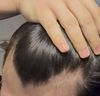
A user's 18-month hairline progress using minoxidil, finasteride, Nizoral, microneedling, and scalp massage. They share their routine and discuss treatment effectiveness and photo order confusion.
Kintor Pharma finished enrolling and dosing participants in a Phase I trial for a hair loss treatment called AR-PROTAC (GT20029). The effectiveness of another drug, pyrilutamide (KX-826), for hair loss will be clearer after a Phase 2 trial expected to complete in January 2023.
A 21-year-old woman diagnosed with male pattern baldness (MPB) who is considering treatments such as spironolactone, minoxidil and finasteride to address her hair loss. The user also discusses potential solutions for concealing the appearance of her thinning hair, such as wigs or haircuts.
A user is treating hair loss with Dutasteride, Minoxidil, RU58841, Derminator 2, Vitamin D, Biotin, and Zinc. After 6 months, there's no significant visual improvement, but the user feels less insecure about Retrograde Alopecia.
An 18-year-old has been using 5% topical minoxidil for 2 months for hair loss, with a history of vitamin D deficiency and thyroid imbalance. Users suggest starting finasteride and blocking DHT for androgenetic alopecia (AGA).
PP405 is a topical gel being tested for hair regrowth in adults with androgenetic alopecia. Volunteers aged 18-55 are needed for a 16-week trial in several US locations.
CRISPR shows promise for treating hair loss by targeting specific genes. Current treatments include Minoxidil and finasteride, but CRISPR could offer a more precise solution, though it is still expensive and in early stages.
The user has been using oral minoxidil and dutasteride for hair loss without success and is considering adding topical 17α-estradiol, Pyrilutamide, Clascoterone, or cetirizine. They have confirmed low serum DHT levels and are exploring additional treatments due to genetic sensitivity to DHT and prostaglandin D2.
KX-826 is undergoing Phase III trials in China as a potential treatment for male pattern baldness, with some users considering it as an alternative or addition to finasteride and dutasteride. Opinions on its effectiveness vary, with some users reporting positive results and others finding it expensive and ineffective.
Fatty acid metabolic signaling can activate epithelial stem cells for hair regeneration. Oleic and palmitoleic acids showed the best results, but practical application on humans remains uncertain.
A 21-year-old shares their one-year progress using finasteride for hair loss, experiencing initial shedding but eventual regrowth, especially on the crown. They consider switching to dutasteride due to continued hair loss at the front temple and mid-scalp areas.
GT20029 and KX826 are promising hair loss treatments, with GT20029 increasing hair count and KX826 showing significant results. KX826 may be a good alternative for those who can't use finasteride or dutasteride, though results vary.
A 22-year-old man has seen significant improvement in his hair loss after 18 weeks using Minoxidil and Finasteride, starting treatment after rapid hair loss since age 17. He applies Minoxidil directly after an unspecified procedure, believing it's more effective and appreciates the sterilizing effect of the ethanol in it.
The post and conversation discuss KX-826 (pyrilutamide) for hair loss treatment, with positive remarks about its advertising and authenticity in China. The user changed their perspective after further research and seeing genuine advertising.
A 19-year-old male experienced significant hair loss, initially thought to be male pattern baldness (MPB), and used minoxidil and briefly finasteride. After realizing the issue was telogen effluvium (TE), he improved his diet and supplemented with vitamins, which led to substantial hair regrowth.
The conversation is about the potential benefits of Rapamycin for hair pigmentation and regeneration, based on effects observed in mice. The original poster is seeking personal experiences from others using Rapamycin for longevity.
BPC-157 may promote hair growth by increasing angiogenesis, similar to how Minoxidil works, though no direct research confirms this yet. Users report combining BPC-157 with Minoxidil and finasteride for better results, but concerns about long-term safety exist.
Hair regrowth and gender transition using finasteride, estrogen, and spironolactone. Significant hair regrowth and personal transformation were achieved through hormone replacement therapy.
Pyrilutamide is a selective AR antagonist with a high binding affinity, making it effective in competing with DHT for androgen receptors. The 1% concentration is more effective than the 0.5%, but the latter may suffice for mild hair loss; the drug is considered a good option for those avoiding 5AR blockers due to side effects.
An 18-year-old is maintaining a stable hairline using Minoxidil, topical finasteride (Fynzur), and Dermastamp, and is considering adding oral finasteride for prevention. They seek advice on whether starting oral finasteride early is necessary given their family history and current regimen.
A 19-year-old male shared progress pictures showing hair regrowth on his scalp after starting a treatment with Minoxidil and Finasteride on November 24th. He noted improved hair texture and a halt in hair shedding for the past two weeks.
The user has been on a comprehensive hair loss treatment regimen for four years, including Dutasteride, topical and oral Minoxidil, and various other treatments, but has seen little progress and is considering a hair transplant. Despite trying multiple therapies, including PRP and exosome injections, the user is still experiencing hair thinning and is hesitant about trying peptides due to potential cancer risks.
Hope Medicine received a $28M investment for HMI-115, a monoclonal antibody in phase II trials for treating androgenetic alopecia. Some users are skeptical about its effectiveness, while others find the investment and trial results encouraging.
The user is experiencing hair loss and has tried various treatments including topical and oral finasteride, minoxidil, dutasteride, and ketoconazole, but continues to lose hair. They are considering alternative solutions like hair systems due to the lack of improvement and a scalp condition called CVG.
The conversation discusses the safety and trustworthiness of ordering RU58841 from Lyphar Biotech in China, with a focus on pricing and reliability. The user is seeking advice on whether to proceed with the purchase or consider alternative sources.
Considering a hair transplant, using Pyrilutamide, the potential availability of CosmeRNA, and the significance of taking Minoxidil and Finasteride for long-term results.
The user reports slow and steady hair regrowth using Finasteride (1.25mg) and topical Minoxidil (Rogaine, 2x/day), along with occasional use of Nizoral. They have stopped dermarolling.
A 16-year-old is experiencing thinning hair at the front and shedding during showers. He is concerned about potential early baldness and is considering seeing a doctor and taking multivitamins.
The conversation discusses organizing group buys and tracking progress for Kx-826 Pyrilutamide, a hair loss treatment. Participants express optimism about upcoming results and concerns about self-reporting bias.