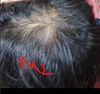
A 21-year-old male with a thyroid condition noticed his hair thinning uniformly without a receding hairline. He is considering using a 5ARI to prevent further baldness if he starts TRT.
The conversation discusses concerns that Anagenic's version of GT20029 might not be as effective or safe as Kintor's, with comparisons to issues faced by pyrilutamide. The chemical structure of the drug has been published.
RU58841 may pose cancer risks due to its antiandrogen properties and lack of long-term safety data. Using it is considered a high-risk experiment with unknown potential for harm.
A quercetin-encapsulated and polydopamine-integrated nanosystem (PDA@QLipo) shows promise for treating androgenetic alopecia by reshaping the perifollicular microenvironment, outperforming minoxidil in hair regeneration. The nanosystem promotes cell proliferation, hair follicle renewal, and recovery by scavenging reactive oxygen species and enhancing neovascularity.
A 21-year-old shares their one-year progress using finasteride for hair loss, experiencing initial shedding but eventual regrowth, especially on the crown. They consider switching to dutasteride due to continued hair loss at the front temple and mid-scalp areas.
The conversation is about finding a reliable Chinese source for pyrilutamide or RU58841, ideally with a third-party Certificate of Analysis from Janoshik Analytical. The user is seeking recommendations for these hair loss treatments.
A user applied the 8T3 product for hair loss, targeting LPP and AGA, and plans to update on its effectiveness. The product uses a saline buffered phosphate vehicle, suitable for those intolerant to ethanolic vehicles.
A dermatologist checked for hereditary hair loss using blood tests and plans to perform a trichogram. The user had slightly low Vitamin D3 levels, and the trichogram may help confirm androgenetic alopecia.
A group buy for testing a compound targeting Twist1 protein as a potential hair loss treatment. Inhibiting Twist1, which keeps hair follicles in growth phase, may prevent hair loss with minimal side effects.
The conversation is about seeking information on GT20029 from Kintor Pharmaceutical as a potential hair loss cure and inquiring about experiences with CosmeaRNA.
A breakthrough in hair follicle cultivation using induced pluripotent stem cells (iPSCs) has been achieved, producing large hair follicles suitable for transplantation. Clinical trials for this hair multiplication technology are planned in partnership with Yinguan Biotechnology.
The conversation discusses the lack of updates on GT20029 for hair loss treatment, with some users noting recent reports indicating ongoing data collection. There are mentions of other treatments like Pyrilutamide and Minoxidil.
A 23-year-old male is experiencing diffuse hair loss and miniaturization, possibly due to high IGE levels after using tofacitinib. He seeks advice and has not yet consulted a dermatologist.
Hopeful treatments for hair loss, including Verteporfin, Androgen Receptor Degradation, and SCUBE3. These treatments offer potential solutions to slow or stop the effects of androgens on the scalp.
KX-826 (Pyrilutamide) 0.5% and 1.0% solutions showed promising results in increasing hair count for male androgenetic alopecia, with the 0.5% dose slightly outperforming the 1% dose. The treatment was well-tolerated with no sexual side effects, but skepticism remains due to past inconsistencies in trial results.
Amplifica is testing a compound called AMP-303 for hair loss, but it's not Scube3 or osteopontin. The timing for the results from the clinical trial is unknown.
The conversation is about the potential of SCUBE3 to regrow a juvenile hairline. Specific treatments mentioned include Minoxidil, Finasteride, and RU58841.
IGFBP‐rP1 shows potential for treating androgenic alopecia by influencing hair cycle transitions. Increasing IGF-1 levels may have similar effects to Minoxidil and 5-AR inhibitors in reducing hair loss.
A 21-year-old male is using finasteride, minoxidil, and had a hair transplant to address lifelong thin, diffuse hair loss. Progress pictures show changes over two months.
The user experienced significant hair regrowth using oral finasteride 1.25mg daily and a Capillus RX laser cap, with no side effects. Improvement was noticed after 9 months, and shedding stopped after the initial 4-5 months.
A user improved their hair loss from NW3+ to NW1.5 over three years using a regimen of dutasteride, finasteride, Nizoral, biotin, and collagen. They experienced some side effects and adjusted dosages over time, and noted additional benefits like better skin and muscle gain.
The conversation is about finding a legitimate source for RU58841 in Germany, with suggestions including Receptorchem and GeneTherica. Anageninc and Chemyo do not deliver to Germany.
The conversation is about someone looking for specific side effects reported in clinical trials for GT20029, a hair loss treatment. No results or data were found on the clinical trials site.
GHK-Cu is a potent inhibitor of the type 1 5-alpha reductase enzyme in hair follicles, which may reduce hair loss without the side effects associated with type 2 5-alpha reductase inhibitors. The user previously experienced side effects with 5-alpha reductase inhibitors and is considering GHK-Cu as an alternative.
AH-001 is a new topical treatment designed to degrade androgen receptors, targeting the root cause of androgenetic alopecia without the side effects of oral treatments like finasteride. It has shown a strong safety profile and good local tolerability in early trials.
MCL-1 is important for hair follicle stem cell survival, but its impact on human hair regrowth is unclear. Minoxidil and finasteride are the main treatments, with doubts about new discoveries leading to effective human solutions soon.