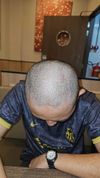
The user is pleased with their hair transplant results but is concerned about the vertex area. They use Minoxidil and finasteride daily and had the procedure at a clinic in Athens.
User tries dermapen for hair loss and plans to use non-mainstream topicals like c60, ghk-cu, and ptd-dbm with valproic acid. They also use a head massager and modified LLLT belt for additional treatment.
A user's experience with hair loss and their successful hair transplant using finasteride to halt the loss for seven years, as well as other treatments such as Dut and RU58841 being discussed.
The user underwent a hair transplant 11 months ago and is satisfied with the results, regaining confidence. Post-operation treatments included oral minoxidil, finasteride, dutasteride, vitamin supplements, and occasional QR678 injections.
The user has been using finasteride, minoxidil, vitamin B12, biotin, vitamin C, resveratrol, zinc sulfate, and Nizoral for 5 months without seeing results. Suggestions include reducing dermaroller frequency and trusting the process as more time may be needed.
The user started using pyrilutamide for hair loss on January 24, applying 1ml daily without other treatments, and after 10 days noticed reduced hair shedding and improved hair quality, with plans to continue for at least 6 months. They experienced chest pain initially, which could be related to starting methylphenidate or pyrilutamide, but the pain has since subsided.
The user experienced new hair growth after switching from oral finasteride to topical RU58841 with minoxidil and undergoing stem cell therapy. They noticed new hairs at the hairline and temples, but are unsure which treatment is responsible.
The user experienced significant hair regrowth using a combination of minoxidil, finasteride, various serums, and micro-needling, leading to increased confidence and consideration of a hair transplant. Despite initial baldness due to past health issues, the user is pleased with the progress and continues to use treatments like Pilgrim, Md Hair, Bodywise Roller, and Bouf serums.
A user shared progress pictures one year after a hair transplant with 2,000 grafts on the crown area. They use topical minoxidil and finasteride daily, along with biotin supplements.
A user shared their hair transplant update, having received 4,300 grafts and choosing not to use medications like finasteride or minoxidil due to potential side effects and personal reasons. Many commenters expressed concern that without these medications, the user might experience further hair loss, suggesting that preventative treatments are important for maintaining transplant results.
Dutasteride and finasteride are not effectively stopping hair loss for some users, despite long-term use. Some are considering or using RU58841, pyrilutamide, and other treatments like microneedling, while also managing seborrheic dermatitis with diet and topical solutions.
The user experienced significant hair regrowth after switching from topical minoxidil to oral minoxidil and finasteride, later transitioning to dutasteride and continuing with oral minoxidil. They reported no side effects and are optimistic about further improvements.
A 22-year-old had a 3,500 graft hair transplant to restore his original hairline and improve density, while using dutasteride and oral minoxidil to manage hair loss. He believes being proactive with medication prevented further loss and allowed for a successful transplant.
Doctors are testing verteporfin topically for healing and potential regeneration after transplants. The user is asking how it is formulated for topical use, such as if it's mixed with a carrier gel.
The user has been using dutasteride, lymecycline, betamethasone, and minoxidil for hair loss but struggles with eczema and dry skin. They feel hopeless as no treatments or moisturizers have helped, and they are concerned about their appearance due to their soft facial features.
A user's extreme regimen for hair loss, which includes taking oral and topical medications such as minoxidil, dutasteride, cyproterone acetate and bicalutamide, but still experiencing miniaturization. Suggestions were made to try other treatments such as RU58841 and Pyrilutamide, while also considering mental health treatment and advice on lookmaxxing.
The conversation discusses the delay in the release of a new hair loss treatment, Pyrilutamide, and speculates on potential safety concerns as a reason for the delay. It also mentions GT20029 as another future treatment option, with a release at least five years away, and touches on the avoidance of research chemicals due to uncertainty about their authenticity.
The user experienced a sudden and severe hair loss after 1.5 years of successful treatment with finasteride and minoxidil. They plan to check their thyroid and vitamin D levels as potential causes.
Hair transplants, oral finasteride, oral minoxidil, and dutasteride mesotherapy are highly effective for treating AGA hair loss. This combination can maintain and improve hair for most people, except those with very aggressive AGA.
A 19-year-old male has been using topical finasteride and minoxidil for 8 months with no progress and is considering seeking a second opinion due to potential misdiagnosis. The discussion revolves around whether the hair loss is due to male pattern baldness, alopecia areata, or a vitamin deficiency.
The user has been using a combination of treatments including Dutasteride, Minoxidil, RU58841, ketoconazole shampoo, microneedling, and low-level laser therapy to address hair loss but continues to experience shedding and density loss. Despite high testosterone and iron levels, the user is frustrated with the lack of improvement and is considering adjusting treatment or exploring other options like a hair transplant.
The conversation discusses the use of peptides C60 and GHK-Cu for hair growth. Participants are sharing their experiences or knowledge about these treatments.
A human trial involving the use of Verteporfin as a treatment for hair loss, which has been ongoing for 119 days with an update on its progress. Treatments such as Minoxidil, Finasteride and RU58841 have also been discussed.
Peptides like GHK-Cu, BPC-157, and TB-500 have significantly reduced hair loss, with GHK-Cu being particularly effective. The discussion also covers the high cost of these peptides and explores more affordable purchasing options.
User reports regrowth at temples and improved hairline density after 6 months of using 0.5 mg Dutasteride daily, topical minoxidil twice daily, and vitamins. Considering adding copper peptide but concerned about overdoing it; experiencing increased shedding on the crown.
A user reports hair regrowth after 4 months using finasteride, minoxidil, black seed oil, GHK-Cu injections, and daily scalp massages, while avoiding shampoo. Another user comments on the negative effects of shampoo.
A 31-year-old male with androgenetic alopecia and seborrheic dermatitis is considering starting finasteride and minoxidil for hair loss, while also using ketoconazole and salicylic acid shampoos for scalp treatment. He is concerned about the timing of starting finasteride and potential side effects, and seeks advice on whether to prioritize scalp health or begin hair loss treatments simultaneously.
A user shared their 14-day recovery progress after a 3450 graft FUE hair transplant in Turkey, noting faster healing possibly due to hydrolyzed collagen supplements. They asked if others had similar experiences with or without such supplements.